


Note: This analysis is intended exclusively for educational and informational purposes. All observations are based on publicly available information and do not involve access to any internal data. For more details, please refer to our Disclaimer page.
In this article we’ll walk through the technical SEO issues I uncovered on one of the most visited sites in Romania – farmaciatei.ro.
I’ll list the findings in descending order of severity, starting with the most damaging issues on the site.
1. The same category page duplicated and indexed multiple times
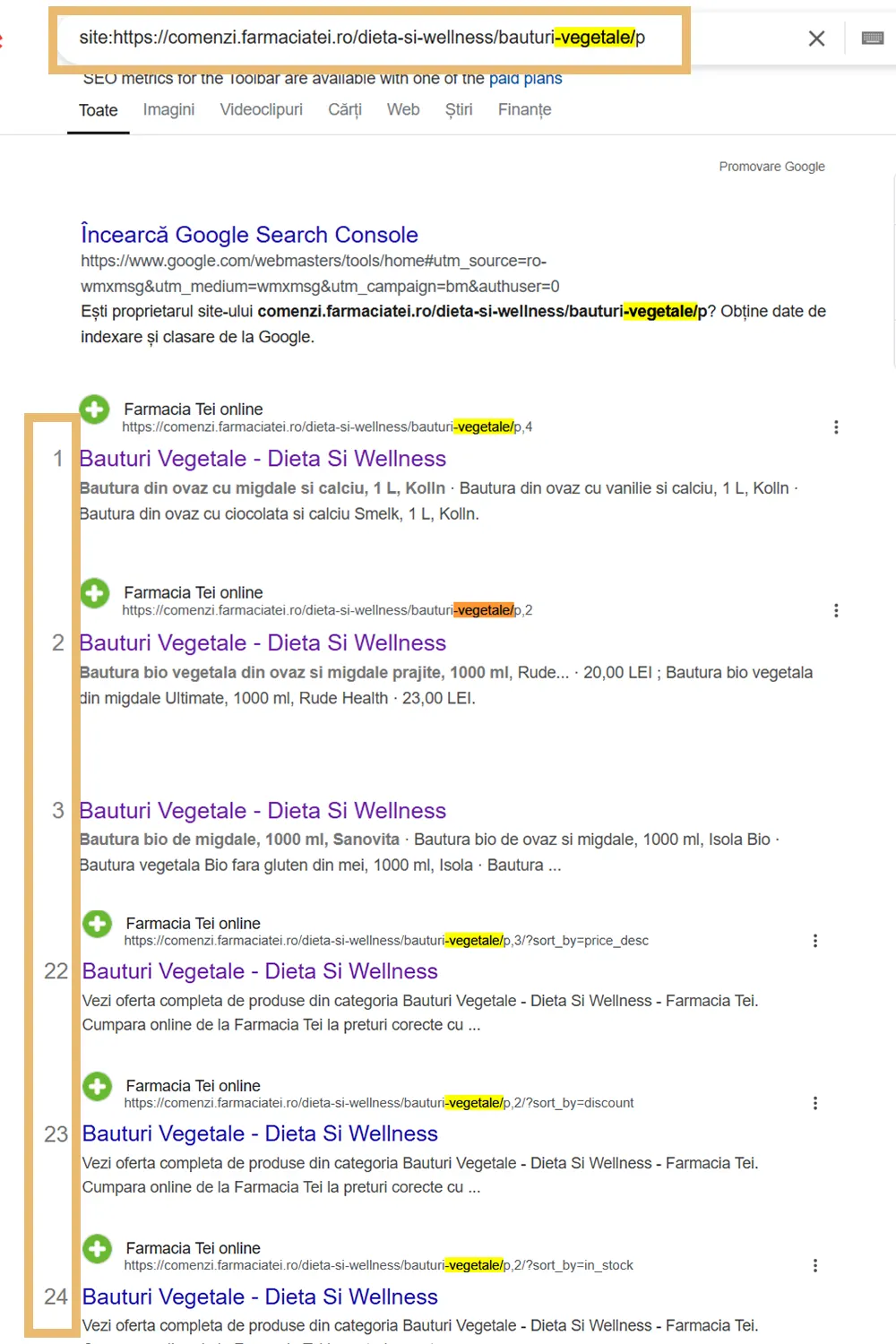
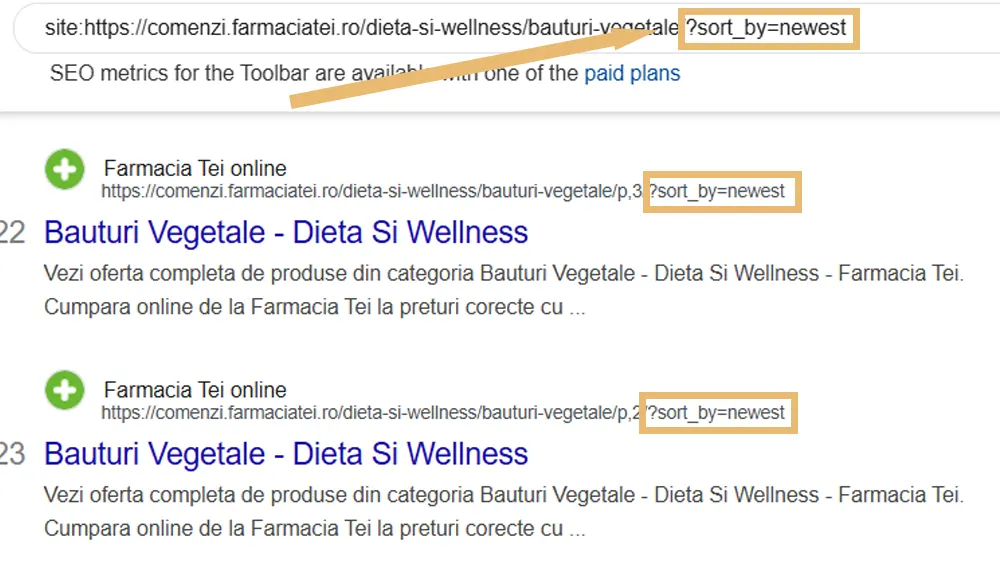
In the screenshot below we can see the same URL…
…indexed 24 times. Some of these pages differ because filters have been applied, but at their core they’re the same category page with the exact same title.
site:https://comenzi.farmaciatei.ro/dieta-si-wellness/bauturi-vegetale/p
A correct implementation with good example
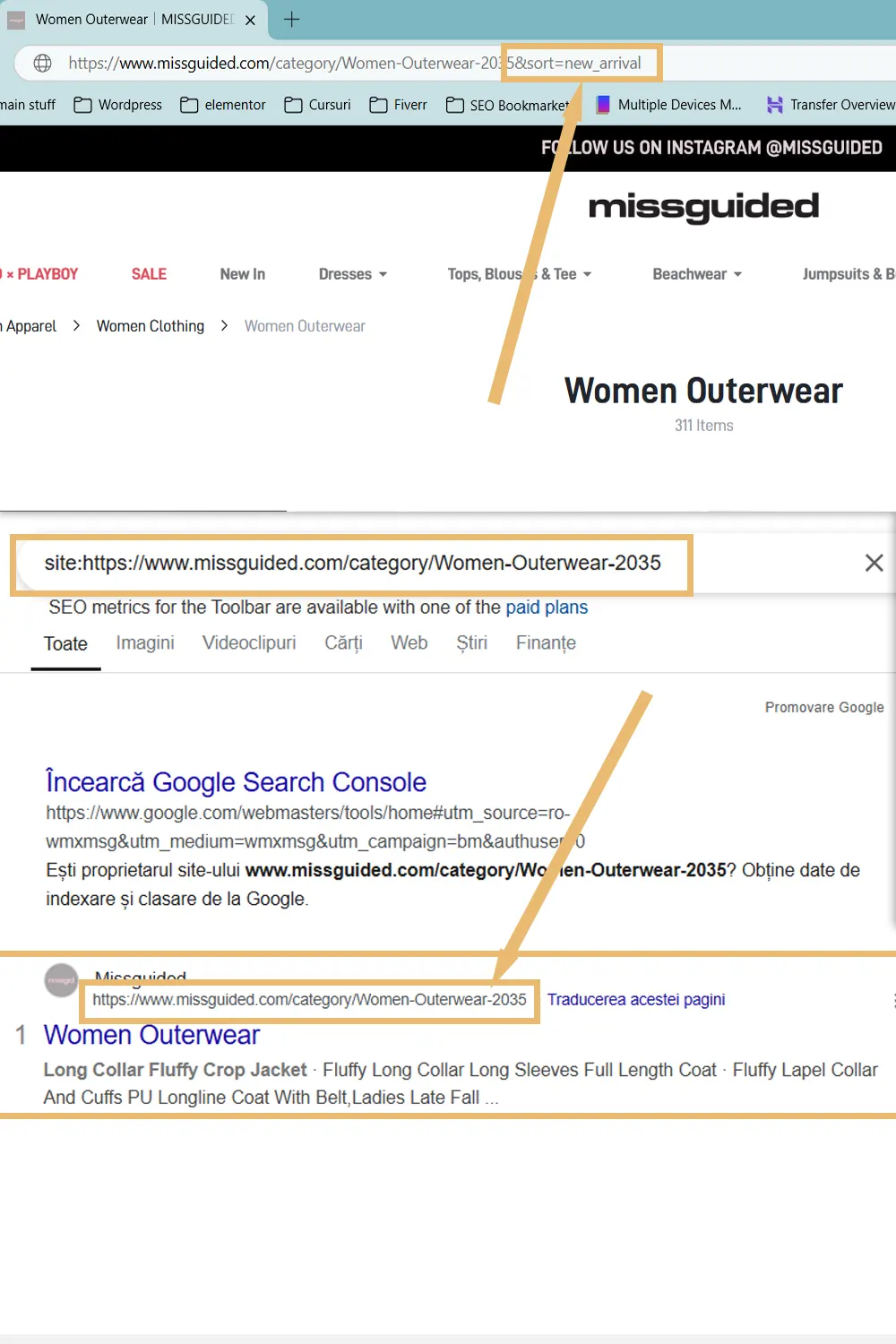
While the same type of dynamic filter URL exists on another product site, a quick check shows only a single indexed page for that same product category.
On farmaciatei.ro, the same type of page with the &sort_by=newest URL parameter is indexed in Google multiple times:
This is just one example. In all likelihood, multiple other categories share the same problem.
Why this is harmful
The primary negative effect here is index bloating – Google ends up spending more crawl budget and time indexing pages that offer no unique value.
This can delay the indexation of new content, and over time may cause Google to view the site less favorably due to the high resource consumption involved (and the larger carbon footprint that comes with it).
The second issue is cannibalization – having multiple pages with the same title and the same products confuses Google when determining which page to rank. As a result, the main category page can suffer in organic rankings.
In practical terms: if someone searches for ‘vegetable drinks (bauturi vegetale)’, Google might rank a filtered variant of the category page rather than the main one – a page showing a reduced product selection, which directly harms the user experience.
site:https://comenzi.farmaciatei.ro/dieta-si-wellness/bauturi-vegetale/ +inurl:?sort_by
Why did this happen?
The root cause is a lack of directives telling Google which page is the canonical one.
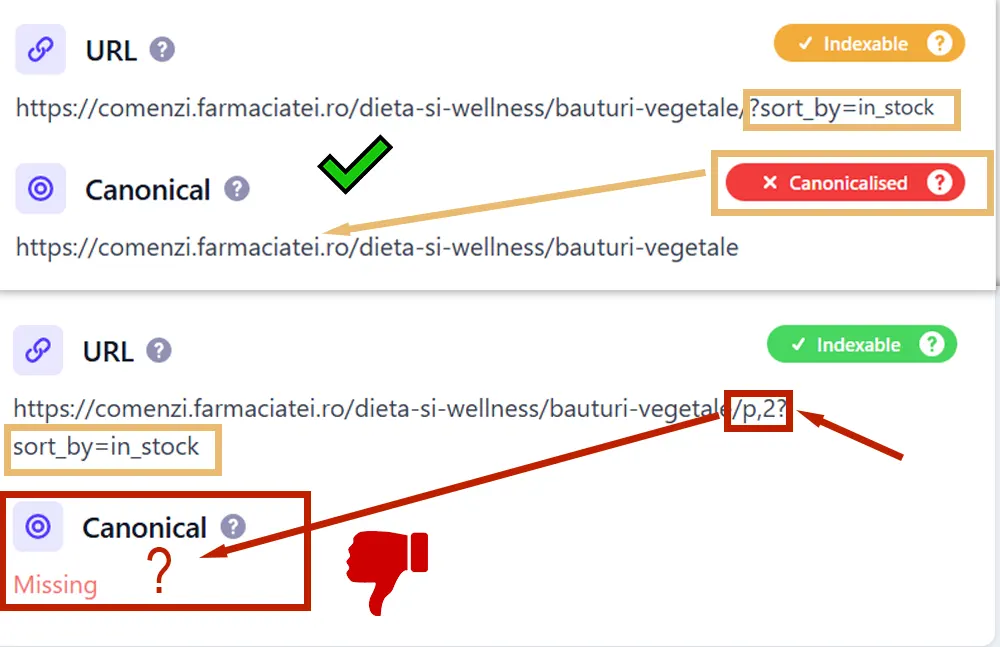
As shown below, these dynamic URLs are indexable and have no canonical tag pointing back to the main category page – so Google treats each one as a standalone page.
Looking more closely, the issue only affects pagination pages. The main category page with sorting filters applied does have the correct directives in place. But once you go beyond page 2 (/p,2), the canonical tag disappears – the exact same problem I found in the Dr. Max audit.
2. The same product on two different pages
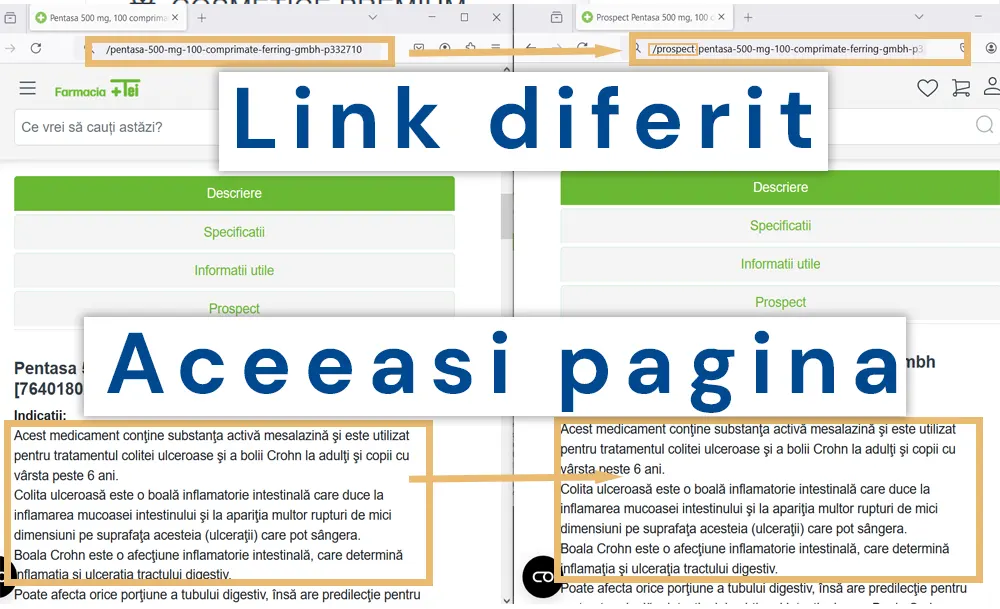
This issue was discovered after the video version of this audit was produced – the same product is indexed twice. The apparent reason is the creation of a dedicated page for the product leaflet.
However, the main product page already contains the leaflet, and the dedicated leaflet page is essentially a copy of it – the only differences being a title that includes the word ‘Prospect’ (leaflet), and the fact that it opens directly on the ‘Prospect’ tab within the product detail tabs. See the example in the screenshot below.
site:farmaciatei.ro Pentasa 500 mg, 100 comprimate, Ferring Gmbh [7640180260684] farmacia tei inurl:pentasa
Why this is harmful
Similar to the previous issue, this creates both index bloating and cannibalization – Google wastes resources indexing the same product twice, and the two pages compete against each other, leading to ranking fluctuations with no clear winner.
3. URLs with and without a trailing slash '/'
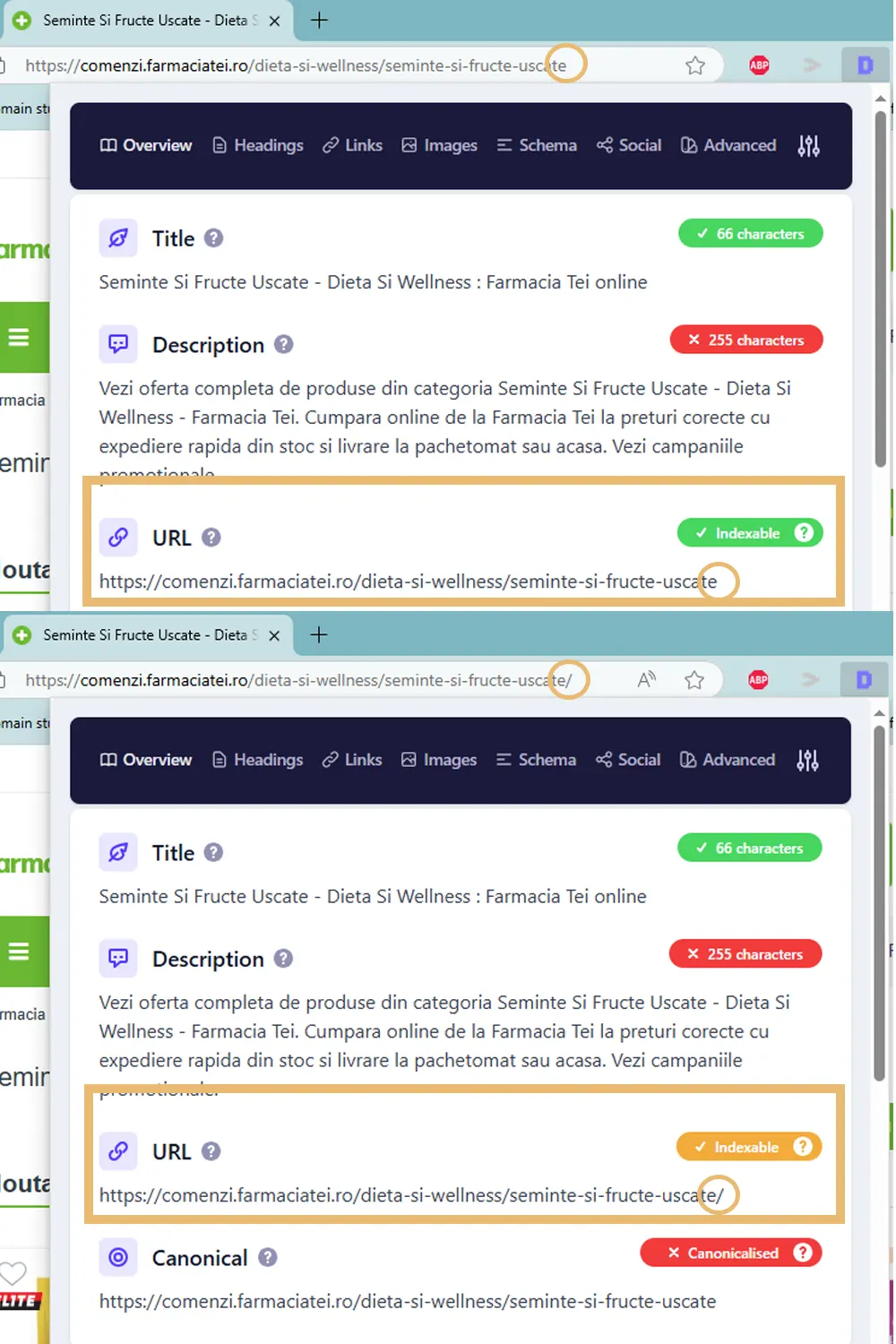
While not strictly a technical SEO issue in isolation, having the same page accessible via two different URL variants isn’t ideal – even when a canonical tag is correctly in place.
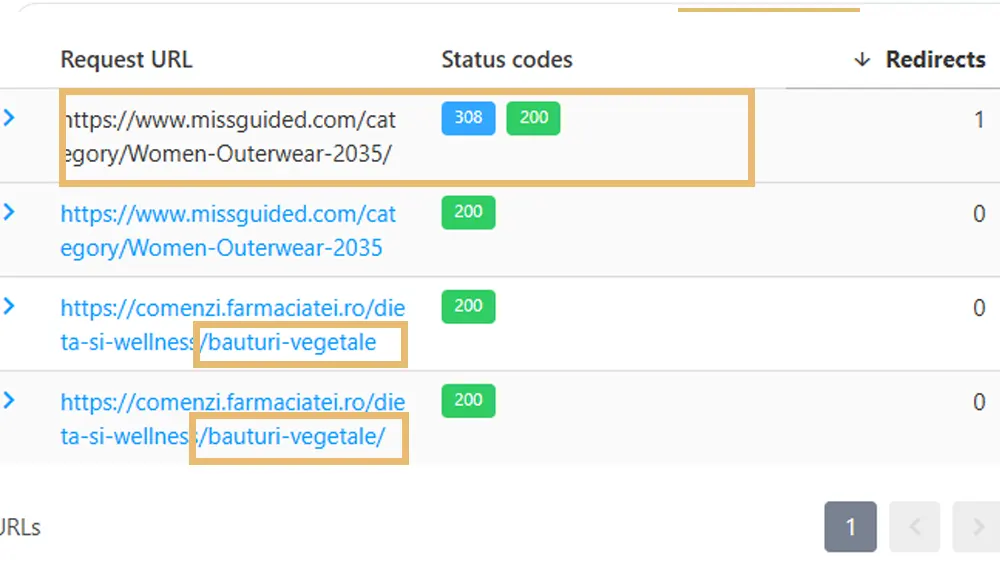
On farmaciatei.ro, both the trailing slash and non-trailing slash versions of URLs are fully accessible. The canonical tag is set correctly, but my preference would be to enforce this with a 301 redirect instead.
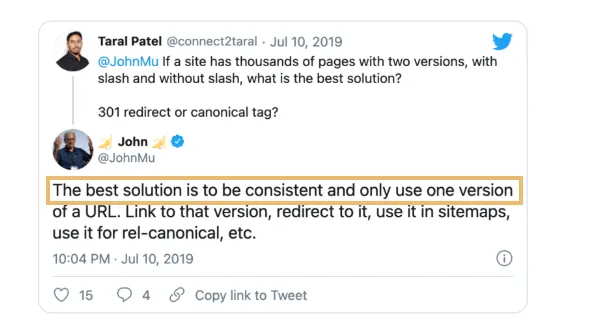
Below is a screenshot of a tweet by John Mueller (Google Search Advocate) recommending consistency with a single URL format across the site.
While his tweet suggests that a canonical tag is sufficient, the vast majority of well-optimized sites enforce this with a 301 redirect between the two URL variants.
Taking the comparison site mentioned earlier as an example, we can see that the version with a trailing slash redirects to the version without one.
- SEO Tip: To inspect 301 redirect and 404 details across multiple URLs at once, use httpstatus.io.
The wrong URL variant is being used internally
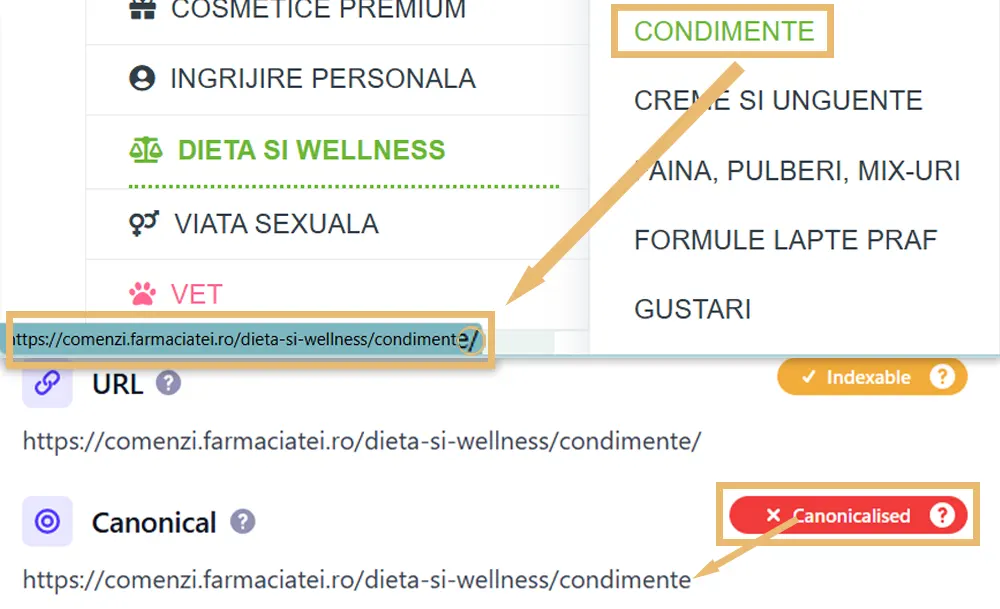
The bigger concern here is that the site uses the trailing slash version internally – meaning every URL in the main navigation menu is effectively self-canonicalized.
What does this mean in practice? A canonical tag carries a risk of not passing 100% of link equity. The homepage is the most authoritative page on any site, and having canonical tags applied to all links on the homepage itself reduces the authority being passed down to category pages.
More technical SEO issues
The three issues above are the most significant ones. Below I’ll list additional findings on farmaciatei.ro that are less damaging but still worth attention.
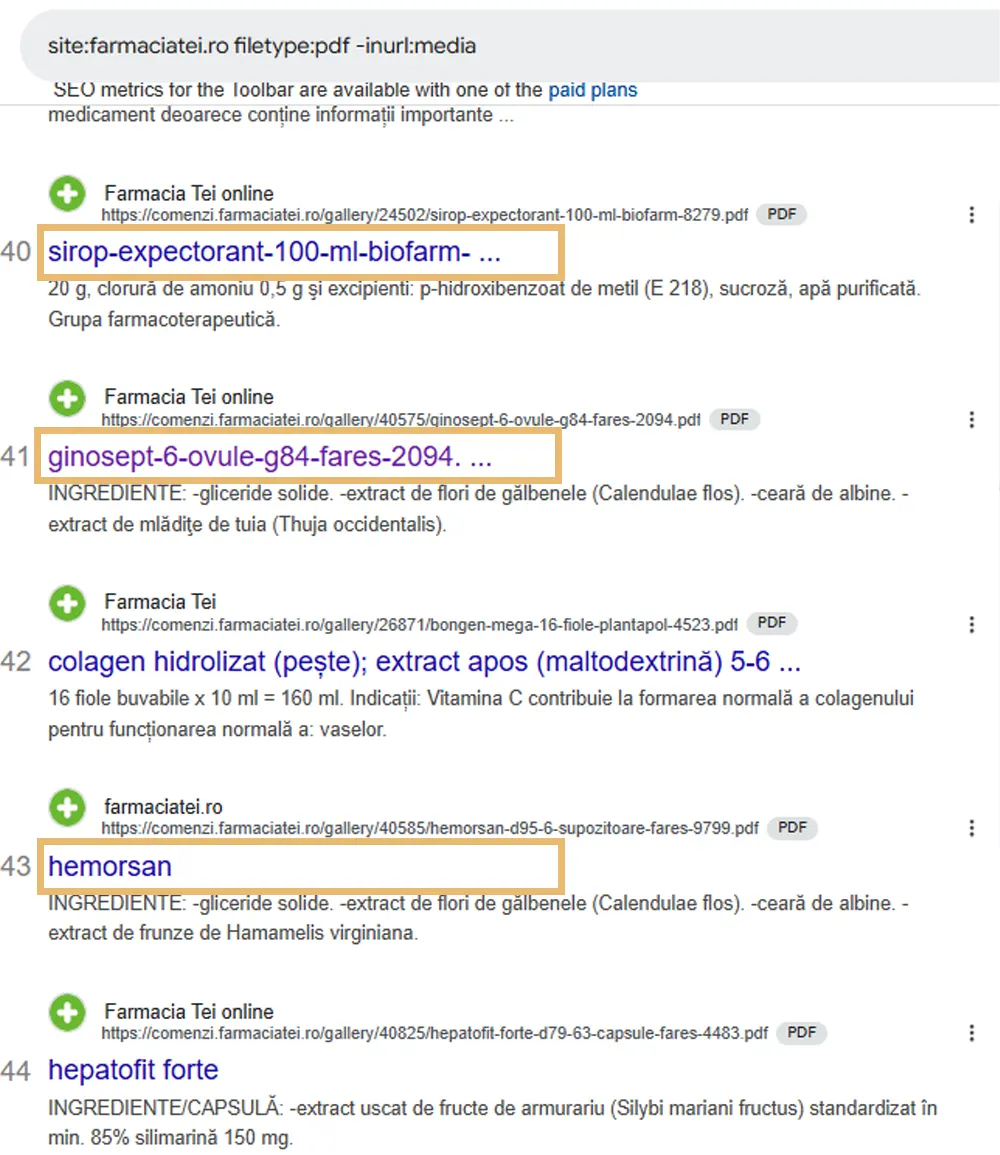
4 .pdf pages that don't appear intended for indexing
An issue found across all the sites I’ve audited – indexed file pages with titles and content that either don’t appear to be meant for public indexing, or have unusual auto-generated titles.
These contribute further to index bloating with pages that most Google users would have no reason to visit.
site:farmaciatei.ro filetype:pdf -inurl:media
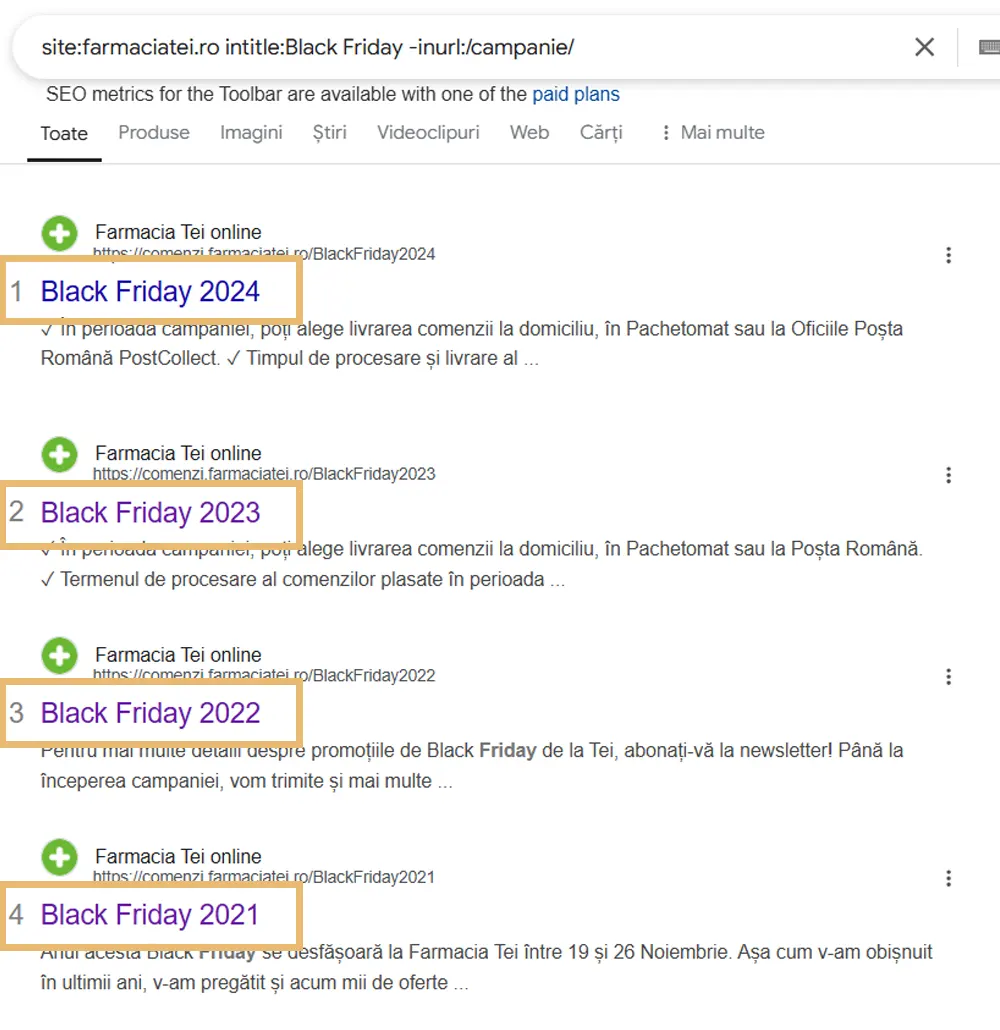
5. Old Black Friday pages still indexed
A lower-priority issue – these are Black Friday campaign pages from previous years that remain indexed in Google.
site:farmaciatei.ro intitle:Black Friday -inurl:/campanie/
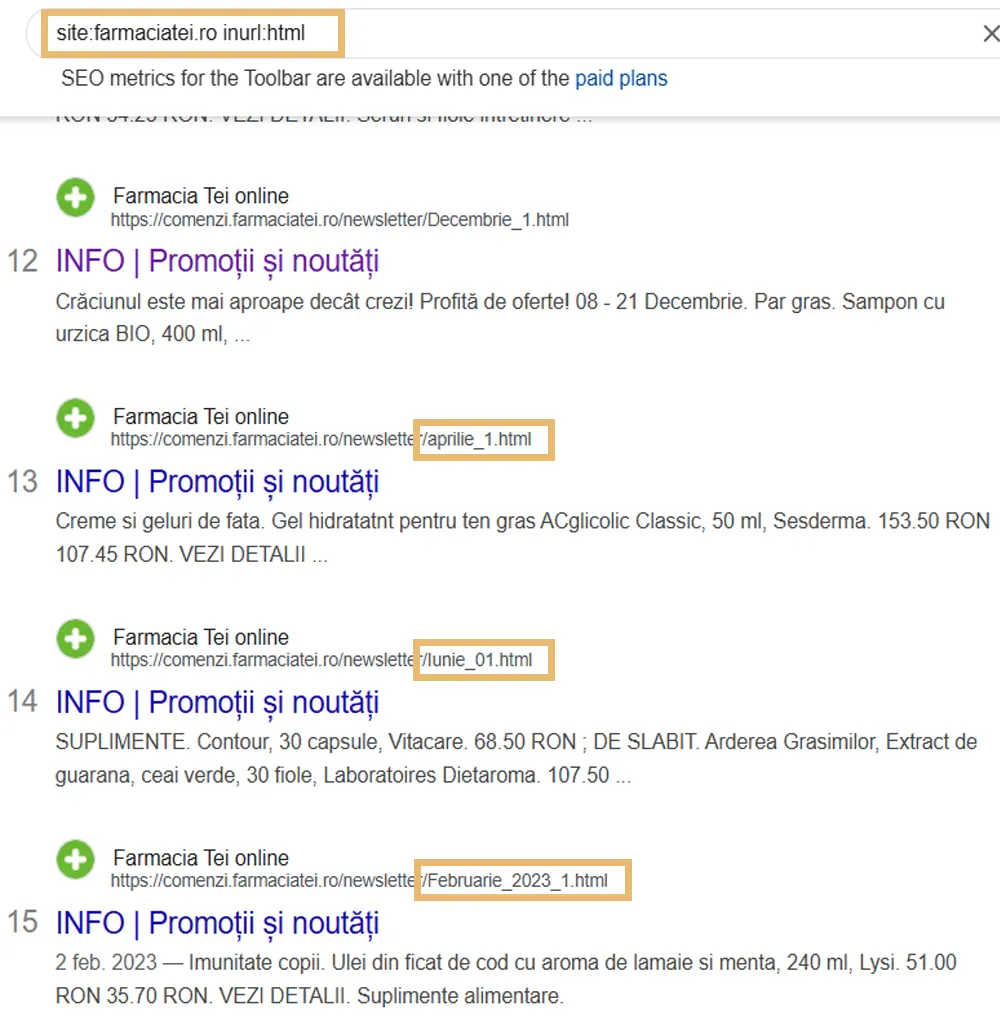
6. Pages from an old site/CMS still indexed
Another category of pages that shouldn’t be indexed – some URLs ending in .html that render differently visually, along with pages for promotions and campaigns that are no longer active.
site:farmaciatei.ro inurl:html
- SEO Tip: To display full URLs in Google search results, use the Chrome extension Remove Breadcrumbs.
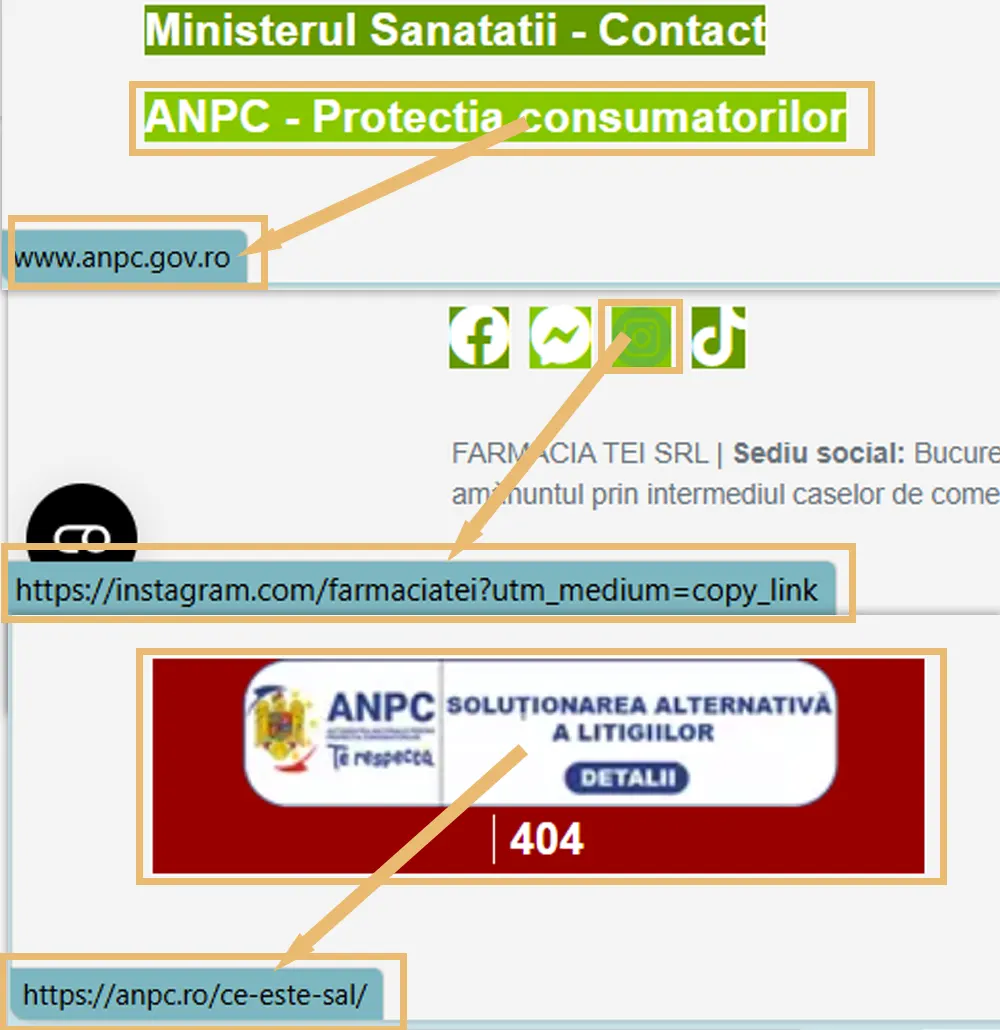
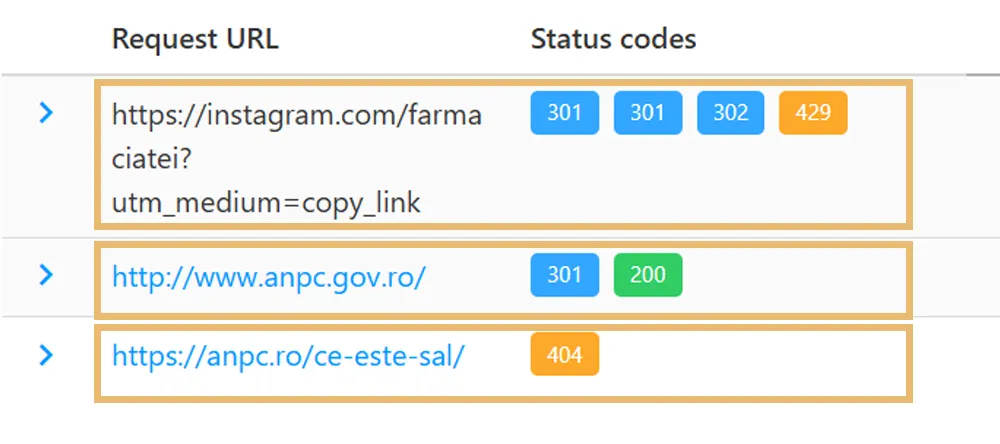
7. Redirects and 404s in the footer
An issue that doesn’t normally cause significant harm on its own – but given that it appears on every page of the site (in the footer) and can be fixed in a matter of minutes, it’s worth addressing.
For a cleaner site and in line with SEO best practices, these should be repaired – especially when they appear in the header or footer.
- SEO Tip: To quickly find broken links on any site, use the Chrome extension Check My Links.
HTTP status of the links above:
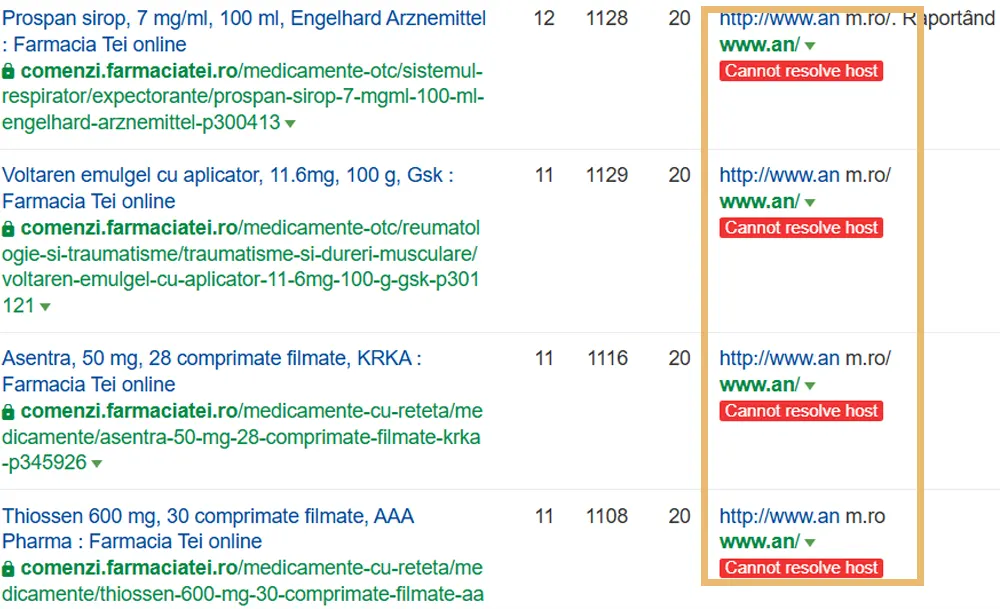
8. External 404 on multiple pages
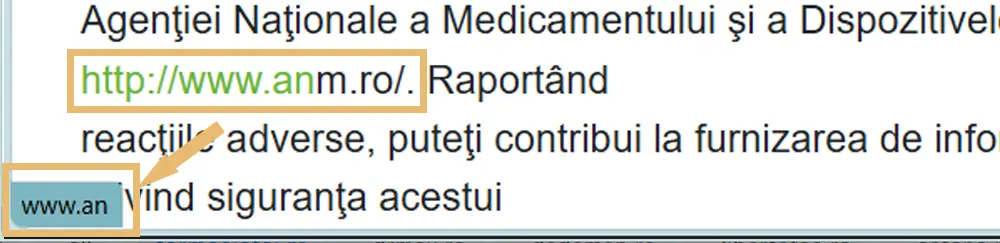
An issue affecting multiple product pages – the link to anm.ro contains incorrect HTML.
This appears to be the result of automation used to generate product descriptions in the ‘Prospect’ (leaflet) tab, as the exact same content appears across multiple products.
https://comenzi.farmaciatei.ro/prospecte/prospect-pentasa-500-mg-100-comprimate-ferring-gmbh-p332710#:~:text=Agen%C5%A3iei%20Na%C5%A3ionale%20a%20Medicamentului%20%C5%9Fi%20a%20Dispozitivelor%20Medicale
Conclusion
To summarize, the most serious issues are:
- The category page is indexed multiple times due to incorrect pagination setup – pagination pages aren’t generating canonical tags correctly.
- The same product has two identical, indexable pages with different URLs – the product page and a duplicate ‘Prospect’ (leaflet) page.
- Both the trailing slash and non-trailing slash URL variants are accessible – and while the canonical is correctly set on the main page, internal links point to the wrong URL variant.
The remaining technical SEO issues are relatively minor and generally straightforward to fix – such as the 301 and 404 links in the site’s footer.
What do you think of this article or this audit series? Leave your thoughts in the comments section below.
If you’re interested in SEO services, visit my Technical SEO Audit page.

My name is Andrei and in 2014 I made my first money online through websites and SEO. I currently offer SEO services for Romanian and English-language websites. Learn more about my SEO approach on my YouTube channel with SEO tutorials. For more SEO education, check my SEO blog or my SEO case studies.