





Whether you’re handling your own SEO or working with an agency, this article will help you identify why your SEO efforts aren’t delivering the results you expect.
Some of the mistakes covered here can make a significant difference to SEO performance, while others have a smaller impact. Some are complex issues, while others are straightforward to fix.
Most of these SEO strategy mistakes are drawn from personal experience, with concrete examples where I can show them in action. This article is primarily aimed at business owners looking for SEO services – but anyone can learn something from it, including SEO agencies themselves.
SEO Problem #1: Lack of a Detailed SEO Analysis
The biggest mistake that causes SEO projects to fail is the absence of a thorough SEO analysis before the project even begins.
A good audit analyzes the site, the market, and the competition, and covers areas such as: analytics data, quick-win opportunities with minimal effort, duplicate content analysis, site structure recommendations, technical issues, and any opportunities to grow sales and organic traffic.
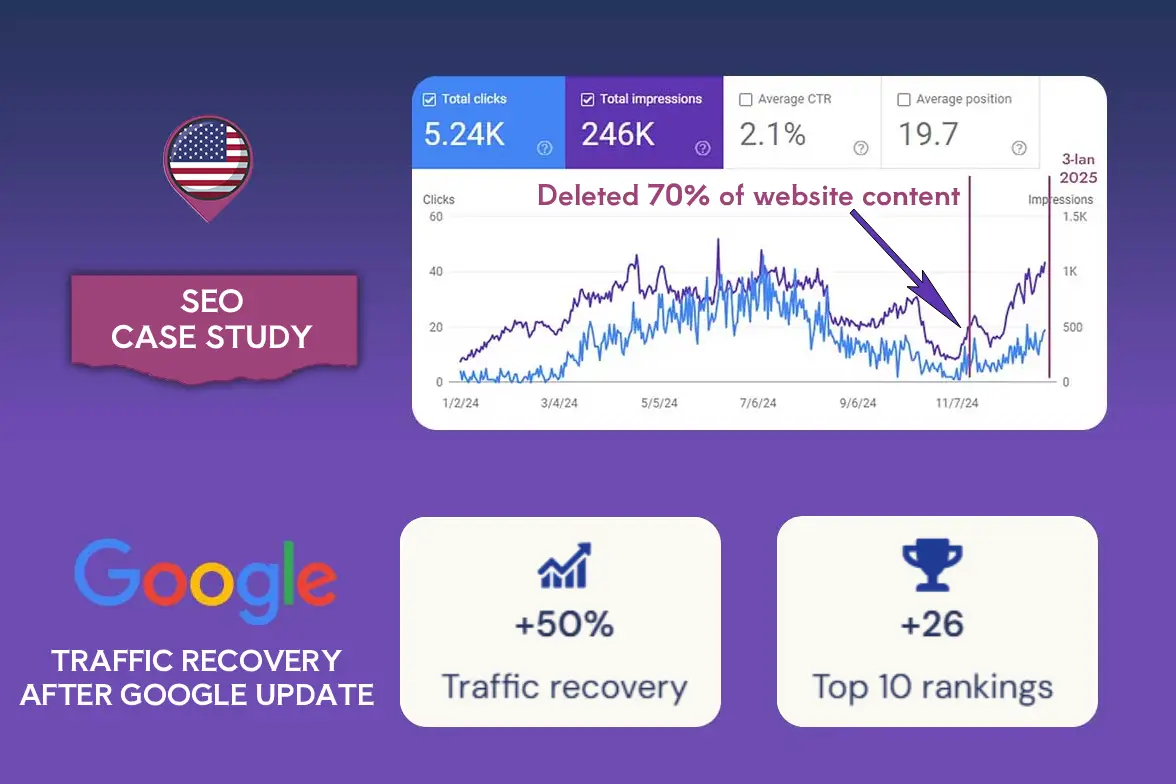
For example, in one SEO test I recovered a site’s traffic by deleting 70% of its content. Without a detailed analysis, I wouldn’t have known exactly which pages needed to go.
If that project had been taken on by an agency that simply kept publishing new articles and building backlinks without removing those pages, progress would have been significantly slower.
- Solution
Ask your agency whether the SEO strategy is data-driven – and ideally ask to see a site audit completed within the first month.
You could pay for 100 backlinks and reach the top position, but if the page doesn’t convert, you’re losing customers. Or you could publish 5 solid articles a month, while 100 other pages on your site are dragging everything down. Without a serious analysis, you risk investing heavily… and going nowhere.
In my own SEO offering, the advanced audit is step zero – I don’t start anything without it.
I’m done with SEO that runs on luck, which is still how many agencies operate. Without knowing exactly where you stand and where you’re headed, it’s just guesswork with the client’s money.
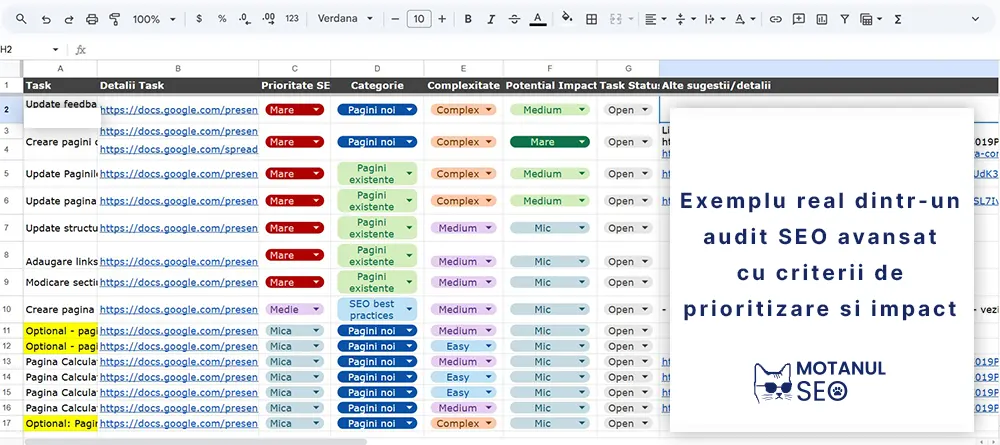
The image below shows a real example of an action list produced from one of my advanced, personalized SEO audits. Each task comes with its own clear instructions, examples, and supporting resources – designed to educate and guide the client, not just hand them a checklist to tick off.
SEO Problem #2: No Periodic Audits
As mentioned above, every SEO project should start with a detailed audit. But the absence of ongoing, periodic audits is an equally serious mistake.
SEO strategies can fail over time if they’re never reviewed and adjusted. What worked a year ago may be completely ineffective today.
Many agencies deliberately avoid recurring audits precisely because they can surface uncomfortable findings – like content that needs to be deleted, content the client paid for in the past. It’s easier to keep delivering monthly deliverables than to admit the strategy needs to change direction.
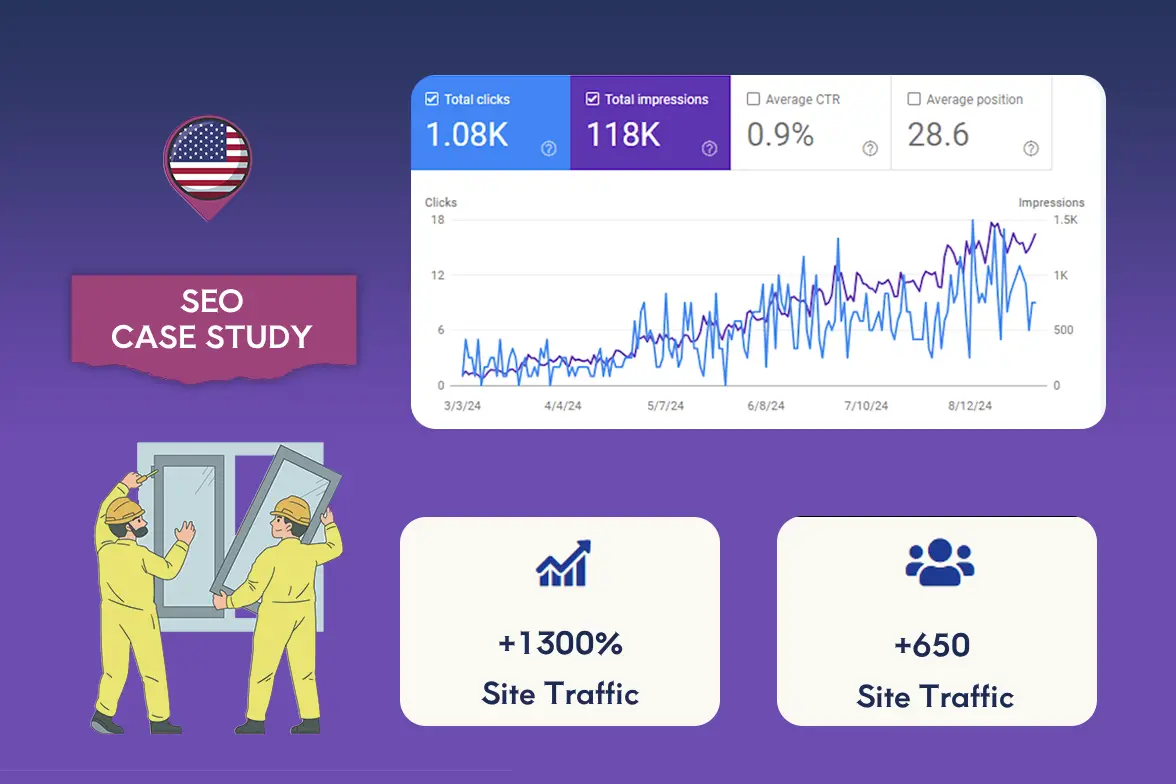
A real example: at an SEO agency where I worked, we had a client who received 6 new pages per month for a full year. After 12 months, organic traffic was still close to zero – see the case study here. The client stayed with the agency only because they were happy with their Google Business Profile results – otherwise they would have left.
It was only through an annual SEO audit that we identified the real problem: the way we were doing keyword research simply wasn’t working. Without that audit, we would have continued in the same direction for another year.
Once we changed our keyword selection approach, traffic started to grow.
(More on the importance of keyword research in point 5.)
There are also external factors you can’t control – but it’s essential to be aware of them so you can identify whether a problem is external rather than internal. The most common of these are Google algorithm updates.
External factors and risks that can affect any SEO strategy
Google’s constant updates Google continuously updates its algorithm, changes how it ranks websites, and adds new elements to the results page. Pages that were performing well can become redundant overnight.
Continuous content production without analysis
If you don’t audit what pages you already have, you risk creating duplicates or cannibalizing pages that were already ranking.
Example: you write an article about “technical SEO audit” even though you already have an older article on “what is an SEO audit” that’s already ranking for both terms.
Shifting search intent
A keyword that has informational intent today can become commercial – and vice versa.
For example, if I search for “technical SEO audit“, Google currently shows me informational results. Over time, Google might decide this is a transactional term and start showing service pages at the top instead of blog articles.
AI Overviews
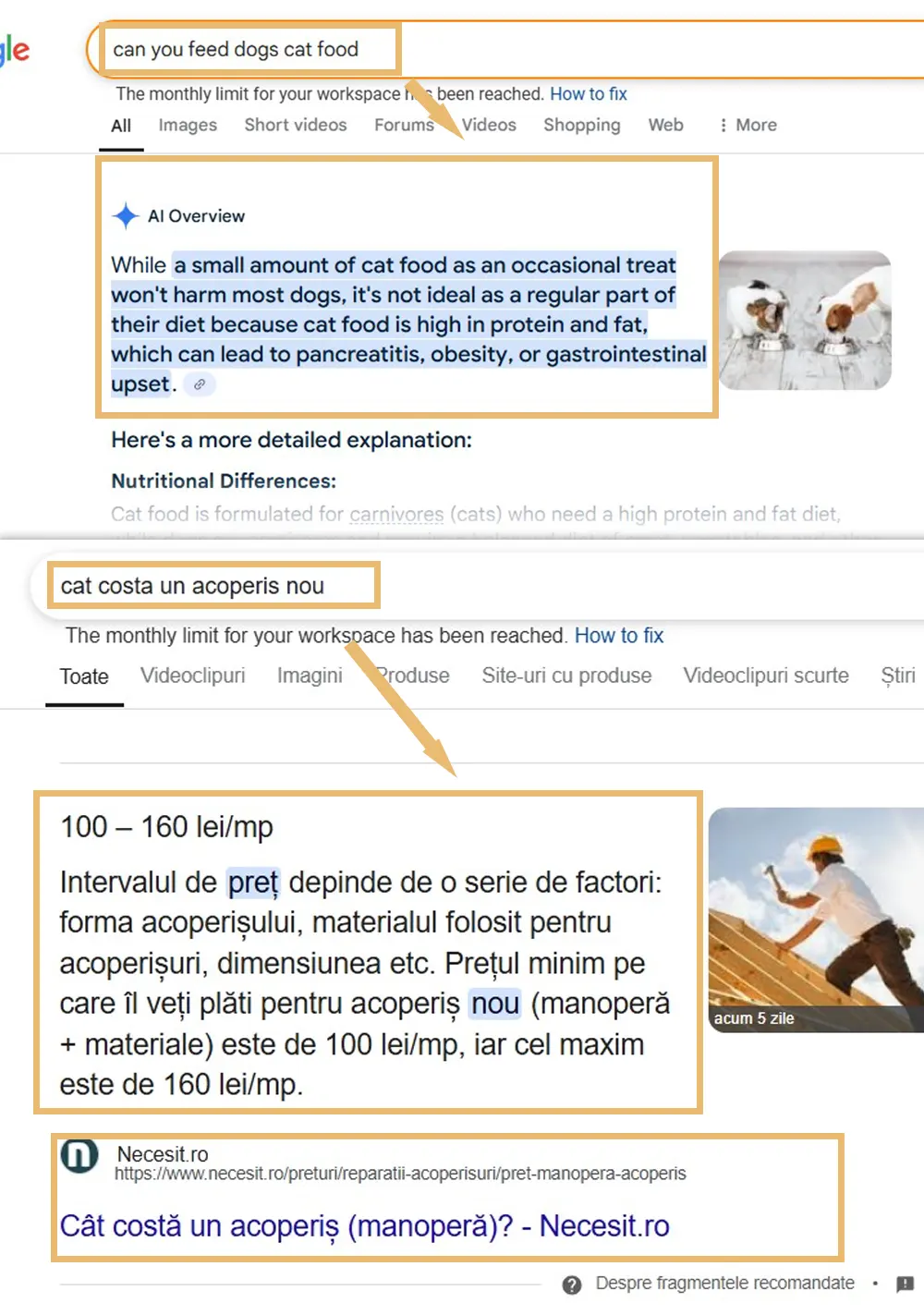
Google is increasingly displaying answers directly in the SERP. In the example shown, Google uses artificial intelligence to generate its own answer for the user.
Featured snippets
Similar to AI Overviews – you can rank in the top position and still get no traffic. Google extracts content from the page and displays it directly in the search results.
If the user gets all the information they need from the snippet, they have no reason to visit your site.
Those were some of the external factors that can cause traffic loss regardless of how well you’re doing SEO.
- Solution
As a business owner, you need to understand that if the agency says there’s an analysis period coming with fewer deliverables, that’s not a bad thing – it’s a sign they want to take you in a better direction, not just tick boxes.
In practice, the absence of periodic SEO audits can be a sign you’re not working with the right agency. You could even proactively request one and see how they respond – that says a lot.
A well-timed audit can drive more traffic growth than all the articles published in the past several months. It’s not about taking steps backwards – it’s about taking stock and charting a better course.
If the agency knows what they’re doing, they should already have audits planned and communicate this in advance, so there are no surprises.
That said, since Google doesn’t announce its next algorithm update, some surprises are inevitable – both for the agency and for you as an SEO client.
SEO Problem #3: Cookie-Cutter SEO Strategies
Another hard-to-avoid problem is SEO strategies applied uniformly across all clients – “for €1000/month you get 5 articles and 5 backlinks.“
Building standardized processes is a necessary part of running a profitable SEO agency. The problem is when the same deliverables and the same strategy is applied to every site, regardless of industry or competitive landscape.
Certain SEO principles can carry over from one site to another – such as the structure of an ecommerce store. But the complete SEO strategy must be adapted to each specific situation, taking into account the level of competition, the site’s authority, and the resources actually available.
I saw this first-hand at a local SEO agency where I worked. For clients in less competitive areas of the US, the standard strategy worked well. But for clients in markets like California – where competition was fierce – that same strategy yielded no results even after 6 months.
In many cases, standard SEO packages include fixed deliverables – “5 articles per month” or “10 links per month” – but a data-driven SEO proposal might look completely different. The site might need a technical restructuring or a handful of well-thought-out pages, not expensive backlinks or blog articles.
Or it might be more important to remove old, damaging content before adding anything new.
SEO is constantly evolving
If there’s no system in place to continuously update and adapt standardized processes based on what’s actually working, you end up applying old recipes to new problems. In SEO, that means stagnation and wasted resources. As I’ve said – Google evolves, and so must SEO strategies.
- Solution
Avoid cookie-cutter SEO packages. Ask the agency directly: “How much of your SEO strategy is standardized, and how much is tailored to my business, my competition, and what I want to achieve?“
If the answer is vague or sounds like a template of “5 articles and 5 links per month”, that’s a red flag. Cookie-cutter strategies can work when there’s no real competition. In those cases, any SEO is better than no SEO.
But if you have active competitors investing in SEO, it’s essential to analyze what’s worked for them and what hasn’t. That’s the only way to maximize your efforts on the actions most likely to have impact – based on actual data.
SEO Problem #4: Wasting Resources on Low-Impact Actions
Let me address the elephant in the room – and I’m sure some people will disagree with me 😂 – that PageSpeed Insights score doesn’t matter nearly as much as you’ve been led to believe.
A quick look at Google’s search results will quickly confirm that spending 10-30% of your time or budget on an improvement that moves the needle by 1-2% simply isn’t worth it.
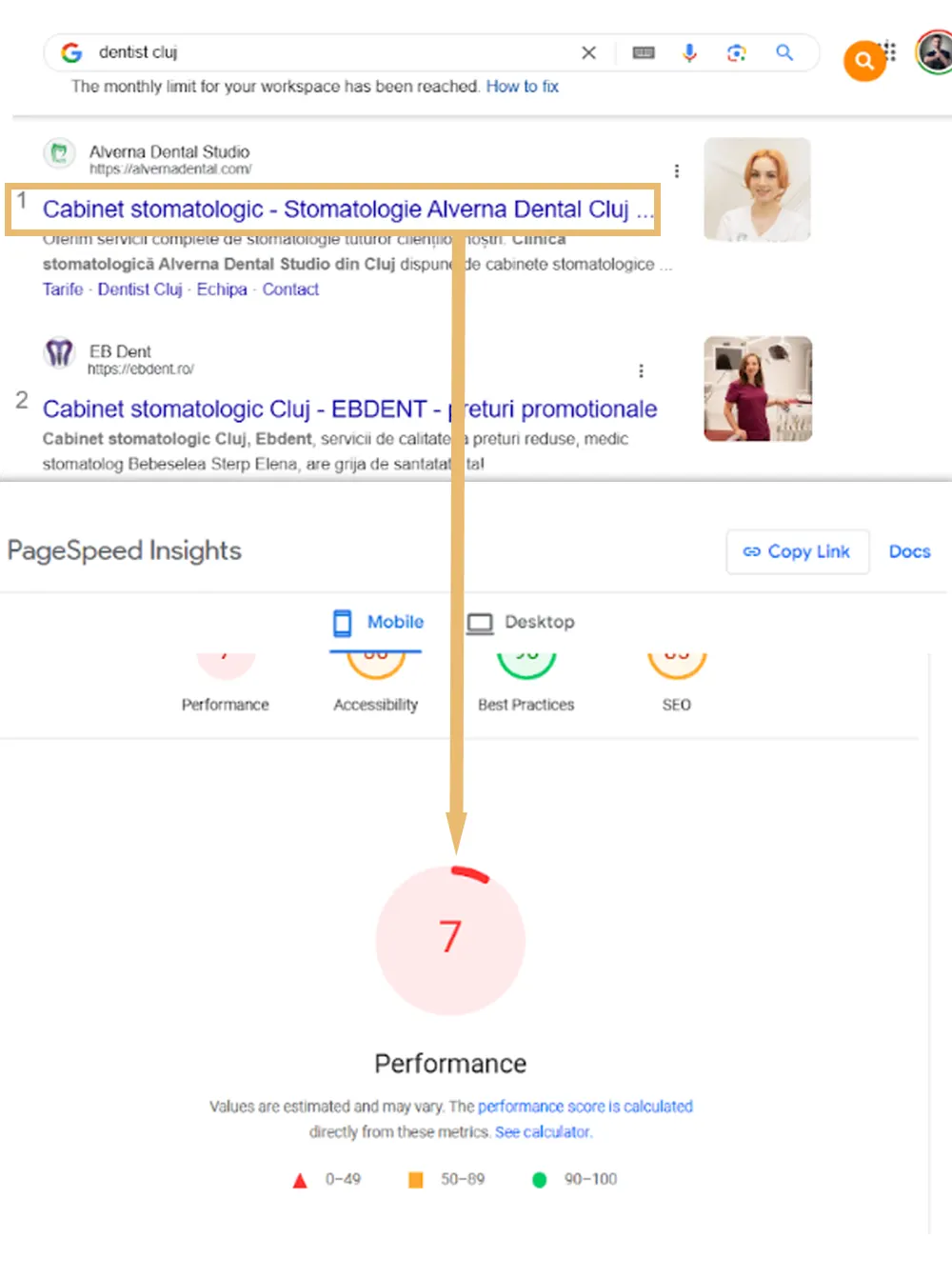
For example, at the time of writing this article, the site ranking first for “dentist Cluj” has a poor PageSpeed score of 7/10.Despite that score, it ranks in first place in a competitive niche and location.
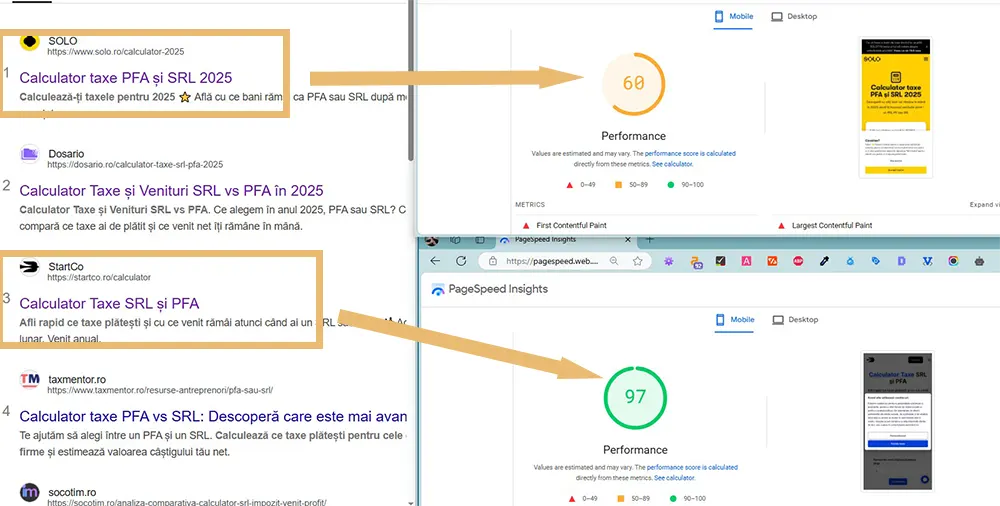
In another example, a site with a score of 97 ranks third – losing to a site with a score of 60.
If an SEO expert tells you to prioritize that score, you can draw one of two conclusions:
➤ Either your site is already perfect and there’s genuinely nothing else to improve;
➤ Or you’re dealing with someone who knows basic SEO but doesn’t necessarily have hands-on experience. Which is perfectly fine, if that’s what you’re looking for.
For reference, here are some other elements that experts sometimes flag as important but generally aren’t:
Keyword density
It’s not 2010 anymore – Google understands context and intent. Tools that measure how many times a keyword appears (like Surfer SEO) can lead to artificial content with no real value.
Google doesn’t need to see the same phrase repeated. It looks for depth, semantic coverage, and connections between concepts – for example, “SEO” naturally connects to “content marketing”, “Google”, or “backlinks”.
Backlinks volumes and misleading scores (DR/DA)
Many people fixate on metrics like Domain Rating (DR) or Domain Authority (DA) – but these are scores invented by SEO tools and have no direct connection to Google’s own metrics.
You can have hundreds of links that look great in Ahrefs, but come from deindexed sites or completely irrelevant ones. These metrics are useful in the right context, but they don’t reflect how Google actually ranks sites.
Article length
You don’t need 2,500 words to rank. If you clearly address the search intent, 500 words can be enough.
An article length that doesn’t match what the user is looking for can actually hurt your site.
Total number of indexed pages
More content doesn’t mean more traffic. As shown in my SEO test, weak pages can drag strong ones down. A technically clean site with fewer but genuinely valuable pages is a solid recipe for online success.
The XML sitemap as a "magic solution"
A sitemap becomes more relevant when you have a complex site with at least a few thousand pages.
If you have a small site with a few hundred pages and you’re having indexing issues – the lack of a sitemap is almost certainly not the cause.
- Solution
This is, in fact, a symptom of the absence of a serious SEO audit. The solution here is to ask the agency for a prioritized action list, each item with an estimated impact – and that list should be based on real data, not just tool scores that anyone can pull.
There’s no point improving your PageSpeed score from 20 to 80 if Google is deindexing important pages, or if the optimization process accidentally breaks essential site elements.
Equally, there’s no point optimizing a page by adding a keyword five times if that page has received zero traffic in the past six months.
Or writing a 2,500-word article when Google is ranking a short 500-word piece in the top position.
Real results come when the agency knows how to prioritize through informed, human analysis – adapted to your unique situation.
SEO Problem #5: Targeting the Wrong Keywords
Choosing keywords might seem simple, but it’s one of the most common reasons SEO strategies fail. Without proper keyword research tailored to the competitive landscape, you risk heading in the wrong direction for months.
Keywords that are too competitive
At an agency where I worked, we targeted the most profitable keywords for a client in California – the ones with the highest commercial value for their business.
We didn’t account for the fact that competing sites targeting those same keywords likely had budgets ten times larger than ours.
The result: 6 months of work and money spent with no results, and a lost client.
Most keyword research relies on tools. Tools like Ahrefs or SEMrush provide valuable data, but they’re based on estimates and projections – they don’t offer real-time data.
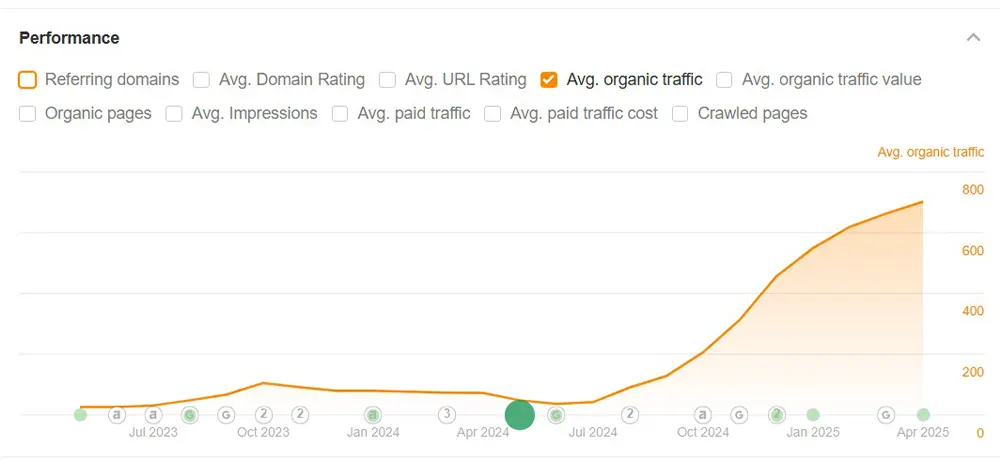
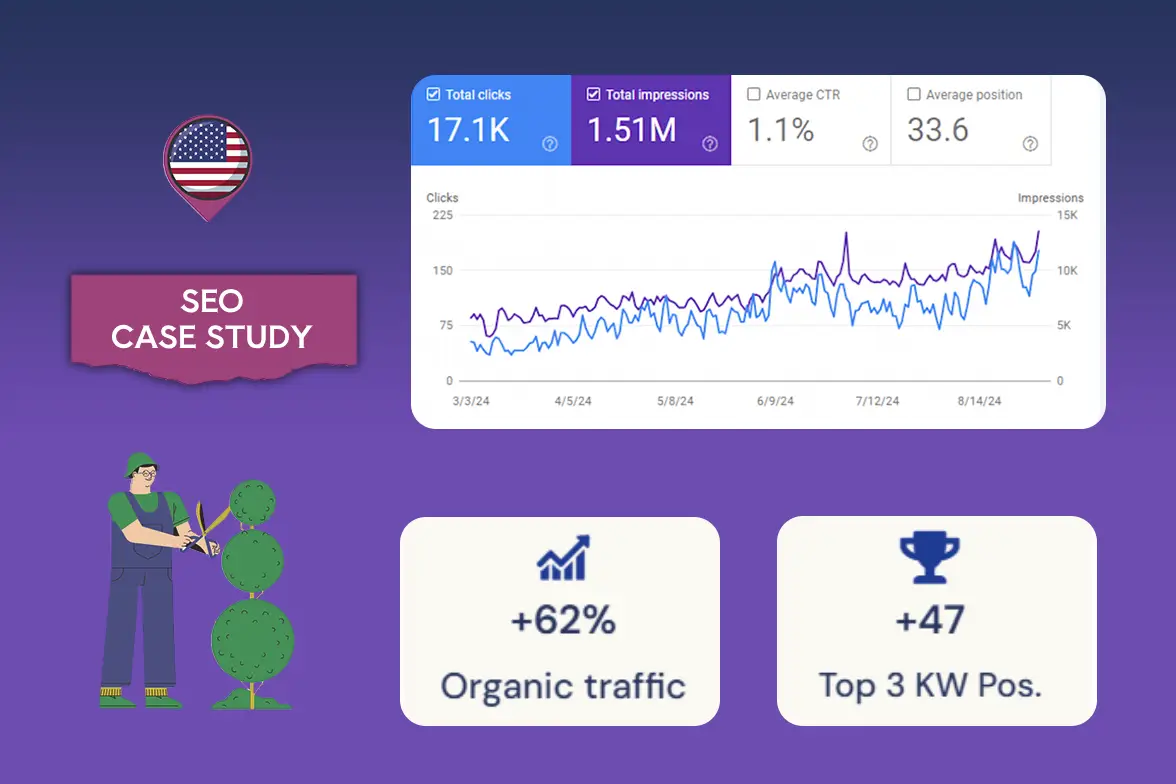
Below is a concrete example of growth achieved with another agency client, after we changed our approach. We stopped relying 100% on tools and started doing keyword research manually, directly in Google, using real-time results.
Content with no real demand
At the opposite extreme, we have content creation for topics nobody searches for. This happens often at agencies that sell fixed packages – “5 articles per month.“
Maybe the team doesn’t do keyword research properly, or maybe there’s simply no time – the end of the month arrives and something gets written just to “deliver the package.“
The result: articles with no traffic, no relevance, or sometimes even inaccurate information. I’ve seen many sites full of content that adds zero value.
Selling something nobody searches for (in ecommerce)
If you’re selling a brand-new product in the market, SEO isn’t the primary channel in the early stages. You’ll need to build awareness through ads and social media content first.
SEO starts to help once people begin searching for that product – meaning they’re already in the interest or decision phase of the buyer’s journey.
All of these situations stem from the same fundamental SEO mistake: keyword research that isn’t properly tailored to the reality of the market and competition.
- Solution
If the agency is producing content and after 1-3 months you see no new traffic, the problem almost certainly lies in the keyword research. Either the wrong keywords were chosen based solely on Ahrefs or SEMrush metrics, or it’s a niche without enough data in the tools and the agency needs to test and build its own analytics.
Here’s the reality: every agency – including those working with your competitors – is looking at the same data from the same tools. Which means you and your competitors will be in a constant game of cat and mouse.
As a business owner, there’s no simple solution. If you’re in a large, competitive industry, SEO tools can be more accurate – but that’s exactly why your agency will end up targeting the same keywords as your competitors.
And if you’re in a small or local niche, the tools don’t have enough data, so you need testing, time, and data accumulation.
On one hand, the solution is patience – assuming you trust you’re working with an agency that knows what it’s doing.
On the other hand, if you’re seeing no results and everything is based solely on what the tools say, it might be time to find someone who understands SEO beyond scores and estimated volumes.
The approach I use – and one I haven’t seen applied in agencies I collaborated with – is to target terms that might be 10-30% less profitable, but with 70-90% less competition. That requires costly manual research using real-time data directly from Google.
SEO Problem #6: Poor Quality Content
Even when the right keywords are chosen, SEO efforts can fail if the content execution is weak, unoriginal, or written simply to “complete” a monthly deliverable.
Google no longer indexes everything
Google used to index every page. But today, errors like “Crawled – currently not indexed” or “Discovered – currently not indexed” appear more and more frequently in Search Console.
The reason behind indexing issues is simple: why would Google spend resources indexing yet another page that says the same thing as a hundred others, just worded differently?
AI isn't the problem - lack of value is
With the explosion of AI, online content has multiplied a hundredfold. Google doesn’t penalize AI content, but it ignores recycled content.
If your information can be recreated by an AI based on what already exists online, Google may decide it’s not worth indexing – even if you wrote every word manually.
You need to bring something new: a personal example, a different angle, more complete information.
Wrong intent or wrong format
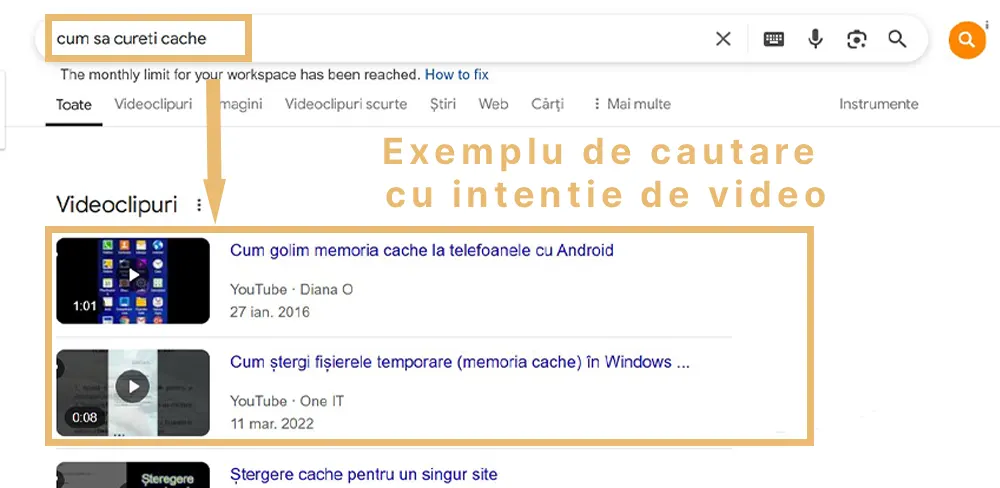
Another frequent cause: the intent or format is wrong. You might have an excellent article on a topic, but Google considers that information better consumed as a video rather than text. For example, searches like “how to clear cache” tend to return YouTube videos in the top positions.
- Potential Solutions
Let’s look at some potential solutions regarding poor content quality issues.
More analysis, less content
Today it’s not about writing more – it’s about analyzing more carefully, especially if you’ve worked with other agencies in the past.
If you publish 5 pages per month and only one drives traffic, that means 80% of your content is dragging the site down.
The solution is periodic SEO content audits – not just at the start of a project. A good audit shows you the following:
➤ Which pages have lost traffic over time (a sign that better content has appeared on that topic);
➤ Which pages never had any traffic (a sign they’re targeting overly competitive or mismatched keywords);
➤ Where a different format is needed (e.g., video, short list, landing page – not a traditional article).
In my process, I compare data from multiple tools across different time periods – this helps me decide whether a page needs to be improved, repurposed in a different format, or deleted.
What you can do as a business owner
If the agency is consistently producing content, a content audit every 6-12 months is essential. Or simply ask: “How many of our pages are actually driving traffic, and what’s the plan for the ones that aren’t?” – if the answer is vague, it might be time to get a second opinion from another SEO agency.
SEO Problem #7: Hidden Technical SEO Issues
Technical SEO mistakes generally fall into three categories: crawling, indexing, and rendering (what Google sees versus what the user sees in the browser).
Crawling errors typically stem from incorrect directives in files like robots.txt or .htaccess, which can accidentally block Googlebot from accessing certain pages.
Indexing issues can be caused by page-level settings such as noindex tags or incorrectly configured canonical directives.
Below are the most common technical mistakes I've encountered in SEO audits:
- JavaScript-rendered sites (CSR) - if a site relies on JavaScript to display menus, products, or content, there's a risk that Google won't see important elements on the page. This is a common problem on sites that don't use Server-Side Rendering (SSR). If your site is built on WordPress or another popular CMS, this is unlikely to affect you.
- Infinite scroll - pages that load new content only as you scroll can be useful for users, but Google doesn't interact with them the same way. Content loaded after a scroll may not be seen by Google, leading to indexing problems.
- Pages blocked in robots.txt - I've seen cases where important files or entire folders are blocked, preventing Google from loading or correctly understanding the page. The reverse also happens: pages that should be blocked aren't, leaving low-value pages publicly accessible and dragging down the good ones.
- Incorrect noindex or canonical tags - a simple misconfiguration in the canonical settings or a forgotten noindex tag can prevent important pages from being indexed.
- Hreflang errors on multilingual sites - missing reciprocal tags between pages, hreflang added via JavaScript, or incorrect tag formats can confuse Google and prevent it from showing the correct version for each country.
- Complicated site structure - sites with deep hierarchies (e.g., site.com/folder1/folder2/folder3/...) or a tangled architecture can be difficult for Googlebot to understand and explore. Ideally, keep your structure simple, clear, and well-connected through internal links between important pages.
- Lack of internal links - if a page isn't linked from anywhere internally, you're essentially telling Google it's not important. Google will treat it as irrelevant or delay indexing it. Internal links help distribute authority and guide Googlebot.
These technical SEO issues appear regularly even on the most popular sites, and can easily go unnoticed without a serious technical analysis. If you want to learn more about technical SEO, check out my YouTube playlist where I conduct technical SEO audits of the most popular sites in Romania.
- Solution
Since these are purely technical problems, fixing them depends entirely on the SEO agency – there’s no way to verify these things yourself without technical knowledge. And it’s completely normal not to have it.
Technical SEO problems are among the most overlooked issues, even by experts. In one real case, an agency showed me a site where pages weren’t being indexed and attributed it to content quality. When I analyzed it, I discovered a rare technical issue that Google was interpreting as an attempt at cloaking – a technique used by hackers.
Even though the behavior was harmless for users, and the site had a real brand, a podcast, and a social media audience, Google was refusing to index pages because of that one negative technical signal.
On the surface, a site can look perfect – like a luxury car. But if the engine under the hood is dead, no amount of bodywork matters. Google sees what’s under the hood. And if nobody’s looking there, you can miss years of growth without ever understanding why.
The solution is to find an SEO agency with genuine technical SEO expertise – not just traditional SEO. Technical problems can occur on any platform, including WordPress, but are especially common on ecommerce sites and JavaScript-built sites.
SEO Problem 8: Organic Traffic Is Up, Sales Aren't
This is a problem that isn’t exclusively an SEO issue. Sometimes organic traffic grows and everything looks good on paper – but sales stay flat.
Traffic without purchase intent
Depending on the SEO strategy in place, traffic might be coming to blog articles and informational pages. Having traffic without purchase intent isn’t inherently bad – these pages help the site build authority with Google and can pass that authority to commercial pages through internal linking.
The problem arises when the money pages that are built to drive sales and conversions are not targeting keywords that usually actually search.
Poor on-site experience
The visitor might arrive ready to buy, but something stops them. A filter that doesn’t work, missing product images, a buggy shopping cart, shipping costs that feel too high, or a product that just seems expensive. There are many elements that can break the journey from visitor to customer.
A tool like Microsoft Clarity can help you identify where the friction points are. Or simply try buying a product from the site yourself on a different device – or ask a friend to do it and tell you if they got stuck anywhere in the process.
SEO feeding retargeting ads
Sometimes users first discover the site through Google, read an article, and leave. Their second or third visit comes through a retargeting ad. If you’re not tracking the full journey, it looks like the sale came purely from retargeting. In reality, SEO was the starting point – it supplied the retargeting platform with an audience built from SEO traffic.
- Solutions
The first step is not to panic. If organic traffic has grown but sales haven’t, it doesn’t necessarily mean SEO isn’t working. Talk to the agency directly and ask what role that traffic is playing: it may well be informational content created specifically to build the site’s authority and trustworthiness with Google.
For an ecommerce site, tracking tools (Google Analytics, Clarity, etc.) should be properly installed. The SEO agency should be able to identify whether there are conversion issues – whether technical errors or design elements that confuse a user who’s ready to buy.
SEO Problem 9: Using Outdated Black Hat SEO Tactics
Even in 2025, there are still agencies using old SEO tactics that have been considered black hat for years. Methods that appear to deliver results when reported through Ahrefs metrics, but that carry no real SEO value.
For example, your report shows a strong increase in backlink numbers and Domain Authority. Everything looks like it’s going well. But many of those backlinks may come from completely irrelevant sites, spam-filled directories, or sites that have been penalized and deindexed by Google.
Ahrefs and other SEO tools have limitations – they can’t detect whether a site has been banned or ignored by Google. So the calculated authority can be entirely artificial.
The result? You receive monthly deliverables, nice-looking charts in the report, but your site goes nowhere.
All because tactics were used that look good on paper but no longer work – and can actively harm your business now and in the future, including when you eventually find the right SEO agency.
- Solution
The solution starts with choosing the right agency. It’s worth doing your research and not underestimating that decision. Look for testimonials and case studies – choosing wrong can mean months of SEO payments before you realize you’ve picked the wrong partner.
If you’re not seeing real results – traffic, sales, leads – then the metrics in your SEO reports are worth nothing.
If something feels off, find the courage to get a second opinion from another agency. An outside perspective can immediately spot whether your SEO is actually SEO.
The industry has long presented SEO as a kind of digital magic – trick Google and make quick money. This led to the perception that expensive SEO agencies are “sharks”, while cheap ones “know the tricks.”
Part of the solution is sometimes a mindset shift for the business owner: the cheaper the SEO service, the greater the chance something shady is going on – and the higher the risk of poor-quality work that damages your site long-term. Sometimes, irrecoverably.
SEO Problem #10: Unrealistic Expectations / Lack of Communication
Another frequent cause of SEO failure has nothing to do with effort or work quality – it comes down to unrealistic expectations and a failure to communicate them clearly.
Again, this brings me back to the need for an SEO audit. A well-executed analysis can show whether a competitor in the top position got there in 2 months or 2 years, and what they actually did to get there.
That kind of data can set realistic expectations for both the agency and you as an SEO client.
Without communication, results can seem wrong
The most common example in my personal experience is the one already mentioned: the client was receiving traffic, and the agency was proudly reporting SEO performance. But since the traffic was coming to informational articles, the client was frustrated because sales didn’t match that growth.
The failure was ours – we hadn’t clearly communicated that the first phase of the strategy was to build site authority before driving traffic to commercial pages.
- Solution
As a business owner, you need to go in understanding that SEO is a process, not a magic formula. If you’re in a competitive market, you need patience, testing, and constant adjustments from your agency.
If no initial audit is offered, expectations are probably being set based on what worked for other clients – clients from different industries with different competitive dynamics.
That’s fine if you’re in a non-competitive niche – but as I’ve said, if you have real competition, you need a personalized SEO strategy.
If the agency isn’t proactively communicating, ask for the details yourself: a list of actions, why they’re prioritized, and how they connect to your goals.
Questions to ask your SEO agency to avoid confusion and disappointment:
➤ How long do you estimate before we start seeing real results?
➤ Do we have a clear plan for the next 3-6 months?
➤ What are we optimizing for: traffic, sales, or authority?
➤ How is the budget split between production and analysis?
➤ How do we know that what we’re doing is actually working?
➤ What’s been done so far, and what’s coming next month?
➤ How do your actions connect to my business goals?
SEO Problem #11: The Domain Is Blacklisted
While this is a rare problem, it’s one of the most frustrating – it can effectively cancel out every SEO effort you make.
You take on a new client, do everything by the book, optimize the site, create great content, but after a month… Google won’t index the site.
It’s the kind of rare situation that can damage your credibility as an SEO expert or agency if you don’t know how to handle it.
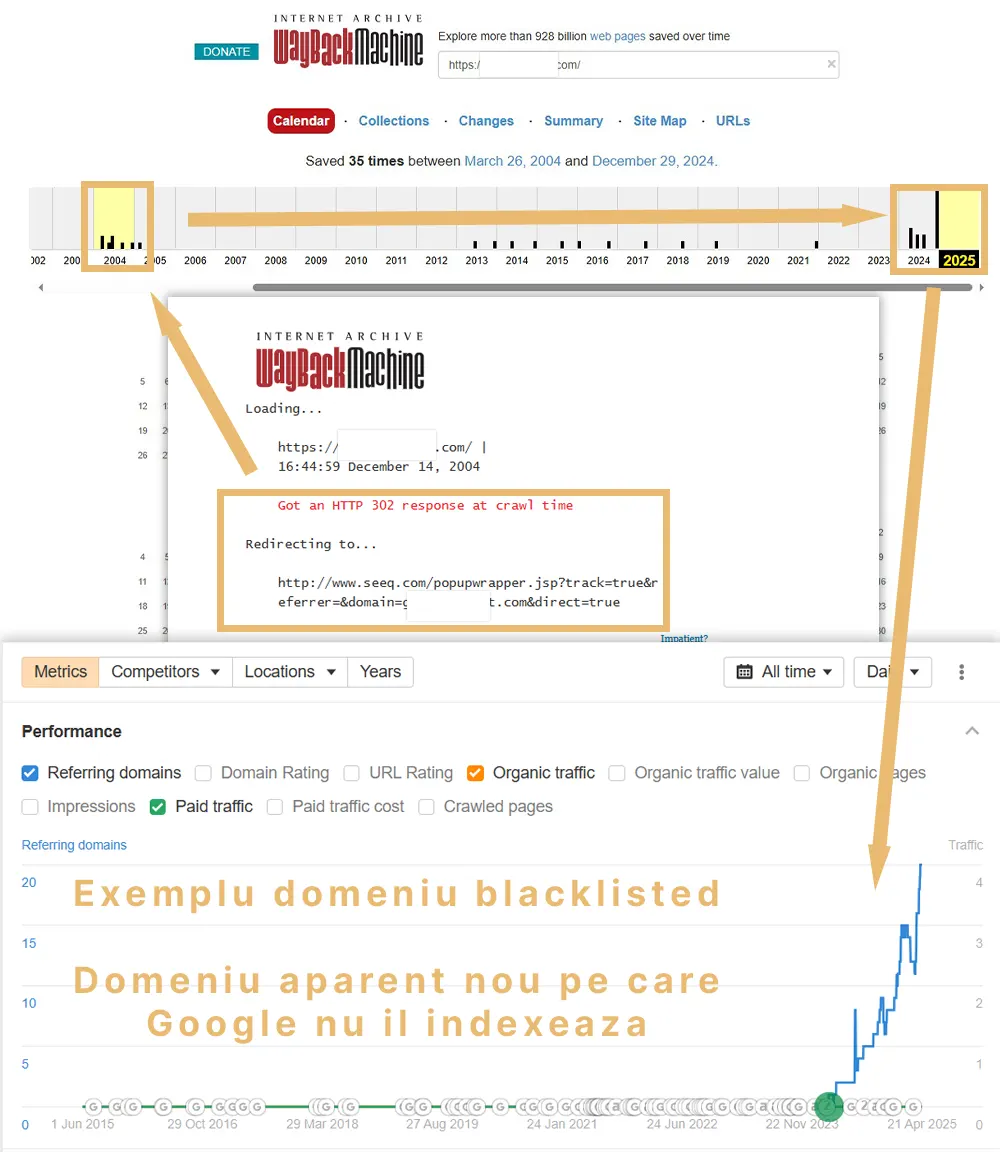
Real case: a client at an agency I previously worked for had purchased a domain with a perfect name for their location and services. After around 30 published pages and 3 months of SEO, the site wasn’t moving.
When we analyzed it, we realized that although the domain appeared to be new, it had previously been used around 20 years earlier.
Google had placed that domain on a blacklist – and after nearly 20 years, it still wasn’t willing to give it a second chance.
- Solution
The first step whenever you buy a domain: check its history in the Wayback Machine to see if it was ever previously registered. Even if it looks brand new when you purchase it, you can never be entirely sure.
If you think you’re already in this situation – the solution is to start fresh with new content on a new domain. Because of the blacklisted domain, Google may now associate that content with spam as well.
The image below shows how to identify the issue – in 2004, this domain had already been used as a redirect to another domain. Despite publishing over 30 pages and acquiring some quality backlinks, Google refused to index it, and it has zero traffic.
SEO Problem #12: Misusing or Misunderstanding AI
Creating content with AI is not an SEO mistake. You can write content entirely by hand with great effort, or generate it 100% with AI – and in either case you might get zero results, or great results.
The difference comes down to knowing what to write and how to use AI to write it.
If you’re already a strong copywriter, you’ll probably also know how to use AI effectively. You’ll recognize when the output is wrong and how to improve it – either manually or through better prompts.
AI doesn’t understand SEO – if you tell ChatGPT to “write me an SEO article“, it will likely produce something worse than if you hadn’t mentioned SEO at all.
So AI doesn’t replace what you do well – it amplifies what you are doing already, be it good or badly.
- AI Search - AEO, GEO, and AI SEO are just trend-chasing labels. The factors that determine your ranking in AI Search are 95%+ the same factors that determine your ranking in traditional Google Search. If you do SEO well, you're doing SEO for all LLM (Large Language Model) platforms without needing to overcomplicate things.
- Solution
First, don’t fall for the trend that says “if you’re not optimizing for AI, you’re losing traffic and money.“ If you do SEO well for Google, results will follow on LLM platforms like ChatGPT, Gemini, Perplexity, Copilot, and Bing.
Second, don’t rely on ChatGPT to write all your articles and content – but equally, don’t be so old-school that you avoid AI altogether. Artificial intelligence amplifies what you’re already doing well or poorly. It can be a tool that propels your business forward, or one that accelerates its failure.
Conclusion
The mistakes behind failed SEO strategies can vary enormously. While most are things you can control, you can also be held back by external factors – or sometimes by your own misconceptions about what SEO actually is.
In my own SEO services, everything starts with a thorough SEO audit and a prioritized task list based on potential impact and required resources.
Technical issues are becoming increasingly important. Web developers sell the idea that a fast site is the key to success – and you get a fast, visually polished site that performs well technically on the surface, but comes with fundamental SEO problems.
I hope this article has helped you understand SEO better. It’s not about tactics and techniques – it’s about understanding your business, your goal, and how to get there based on data and competitive analysis.
If you’ve made it this far, I’d love to hear your take on SEO and your experience with agencies. Have you run into any of these mistakes when your SEO wasn’t delivering results and you couldn’t figure out why?
Note: If you’re unsure about the SEO services you’re currently paying for, we can break it all down in detail with an audit done personally by me. More details here on the advanced SEO audit page. You can also send a WhatsApp message at any time with any SEO questions.

My name is Andrei and in 2014 I made my first money online through websites and SEO. I currently offer SEO services for Romanian and English-language websites. Learn more about my SEO approach on my YouTube channel with SEO tutorials. For more SEO education, check my SEO blog or my SEO case studies.

One comment
yo test