



I’ll admit this technical SEO audit of libertatea.ro felt like new territory from the start – it’s a fundamentally different type of site from everything else I’ve audited: a news site rather than an ecommerce one.
That said, the same technical SEO principles apply, so many of the issues we’ll find are familiar ones. In the interest of full transparency, some of the issues documented in the original file had already been fixed by the time this article was written – specifically some duplicate subdomains that were removed in the meantime.
Separate, indexable comments page
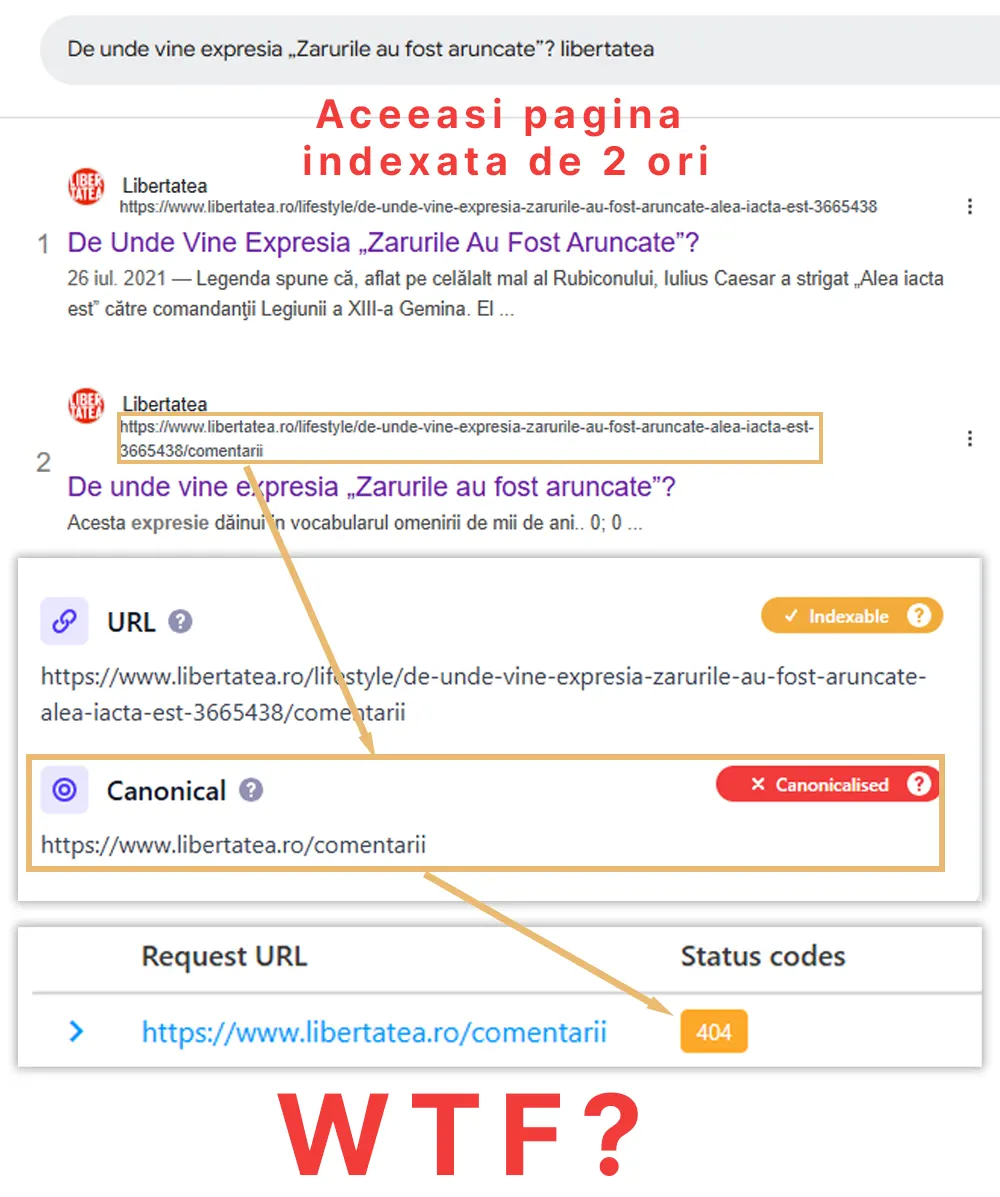
Much like in the Dedeman audit, we have another entry for the ‘WTF’ category 🙂 – where things simply don’t add up.
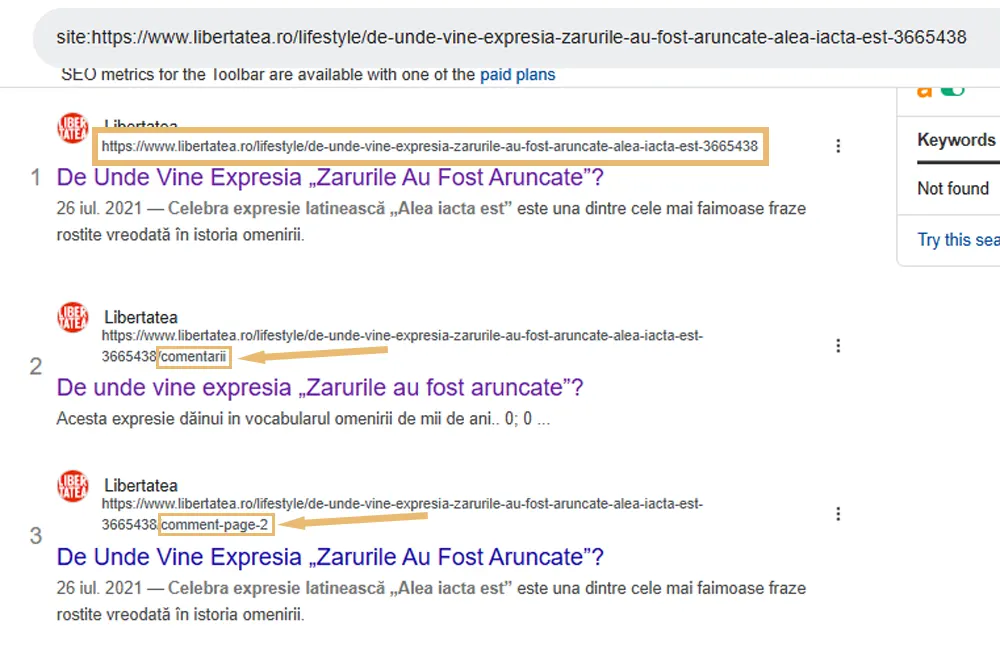
If you search Google for the query below…
site:https://www.libertatea.ro/lifestyle/de-unde-vine-expresia-zarurile-au-fost-aruncate-alea-iacta-est-3665438
…you’ll find pages created separately, solely to display an article’s comments.
To begin with, dedicated comment pages shouldn’t exist in the first place. If removing them entirely isn’t an option, the situation can be handled in an SEO-friendly way through one of the following:
- Making the comments page non-indexable.
- Adding a canonical tag pointing back to the original article URL.
- Blocking any URL containing ‘/comentarii’ via the robots.txt file.
So which of these three approaches was taken? The duplicate comments pages are indexable – and their canonical tag points to a 404 page that doesn’t exist.
In other words, the applied “fix” made the original problem significantly worse.
It gets worse: when an article has a high number of comments, more than two indexable pages are generated. In the example below we can see a second comments page at ‘/comment-page-2‘ – giving us a total of 3 unique, indexable URLs for a single article.
- SEO Tip: To display full URLs in Google search results, use the Chrome extension Remove Breadcrumbs.
Why this is a problem
These extra comments pages force Google to crawl and index additional URLs that add no real value to users – which can negatively affect how Google perceives the overall quality of the site.
There’s also a direct impact on user experience: if someone wants to read the comments on an article, they now have to click through pagination just to view them, or to find their way back to the article itself.
It’s worth noting that sites like Reddit and Quora consistently rank in top positions partly because Google places significant weight on UGC (user-generated content).
By separating comments onto their own pages, we’re effectively telling Google that the UGC has no connection to the article – undermining what could otherwise be a positive ranking signal.
How I would approach the fix
My preferred approach would be to consolidate comments back onto the article page. This not only eliminates the issue entirely, but could also give the article a rankings boost – at least in theory.
If that’s not technically feasible, the next best option would be a global canonical directive that points all comment pages back to their parent article.
Empty pages with images only
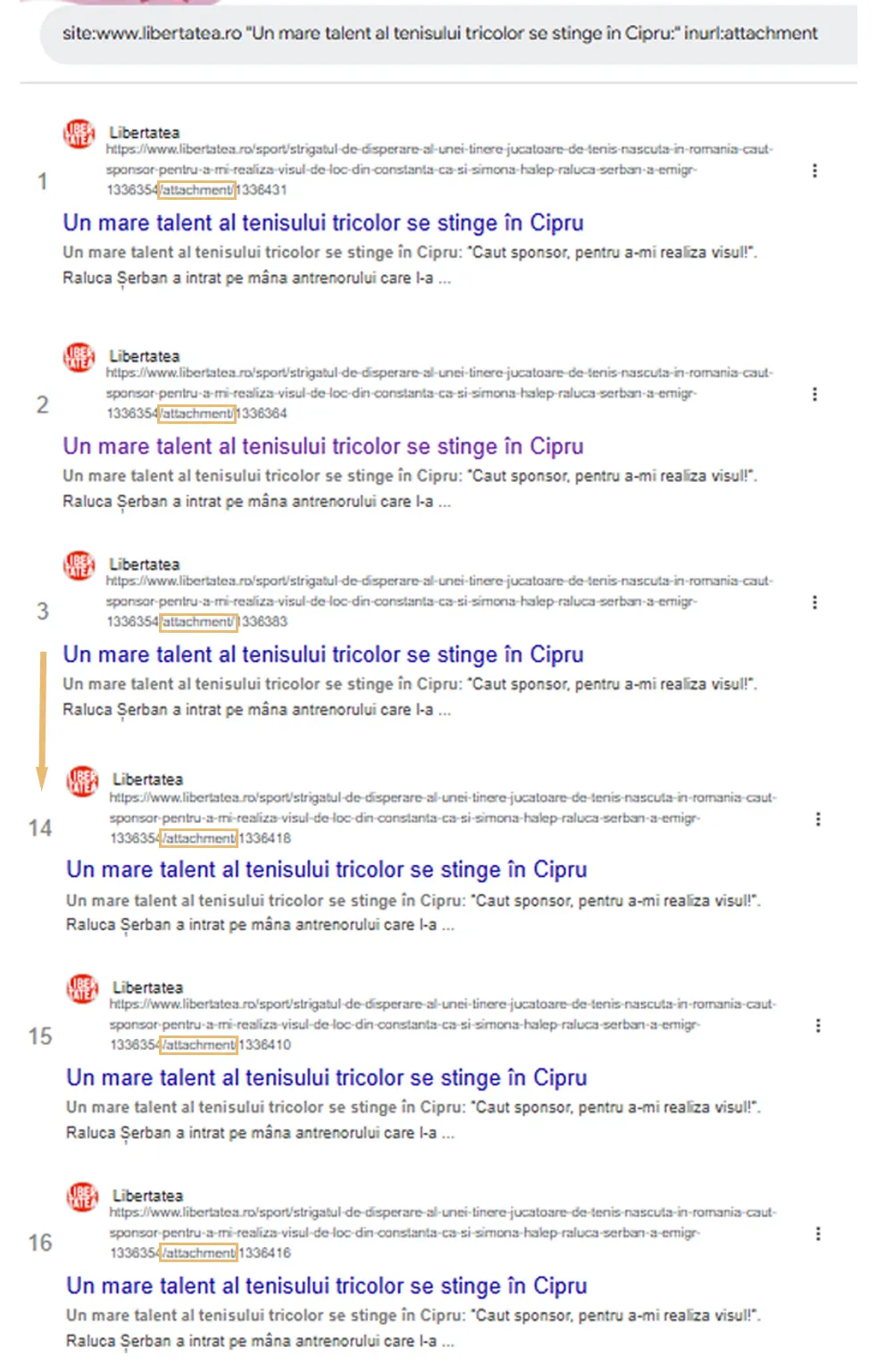
Another issue I discovered is a classic WordPress + Yoast combination: the plugin automatically creates a unique page for every image uploaded to the site. Looking at the URL below…
https://www.google.com/search?q=site:www.libertatea.ro+%22Un+mare+talent+al+tenisului+tricolor+se+stinge+%C3%AEn+Cipru:%22+inurl:attachment&num=100&sca_esv=5791a0164e19b13c&sxsrf=AHTn8zrX6iO0sHiVu9vT4-BcuWtL4DnrLg:1737641553843&filter=0&biw=2124&bih=1031&dpr=0.9
…we find 16 unique URLs (at the moment if the writing this) sharing the exact same title – all empty pages containing only the images attached to a given article.
It’s particularly unfortunate to see this on a site as large as libertatea.ro – the bigger the site, the greater the potential damage from issues like this.
The impact mirrors the previous problem: massive index bloating from pages that almost certainly drag down overall SEO performance.
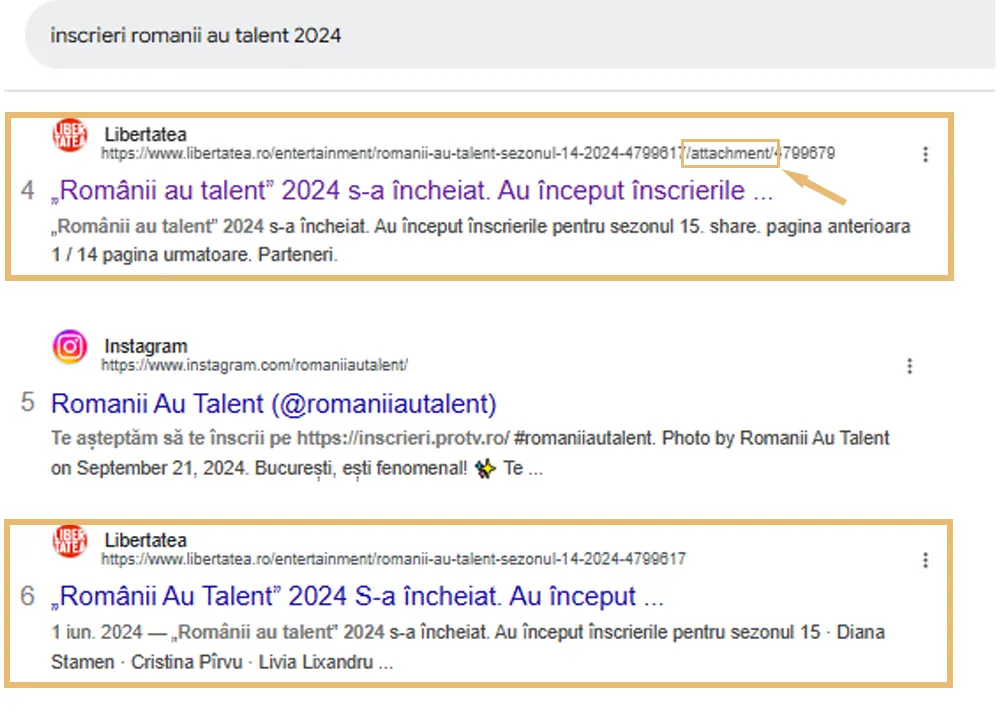
There’s also a cannibalization angle – I found an empty, image-only page outranking the actual article it belongs to. Users landing on that page have no way to reach the article they were actually searching for.
Video I made specifically for this issue
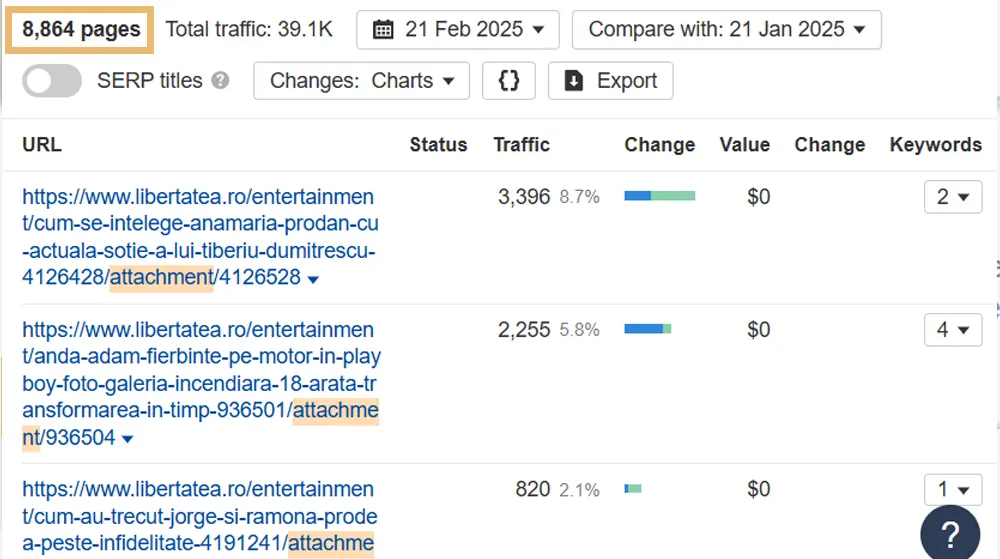
According to ahrefs, there are 8,864 such empty image pages in total. While some do receive traffic, many are likely cannibalizing their full-content counterparts – very few searches are made with the intent of seeing a standalone image.
Other technical SEO issues
Below I’ll cover additional technical SEO issues found on the site. The ones above are clearly the most significant, but the following are worth addressing as well.
URLs with .html extension still indexed
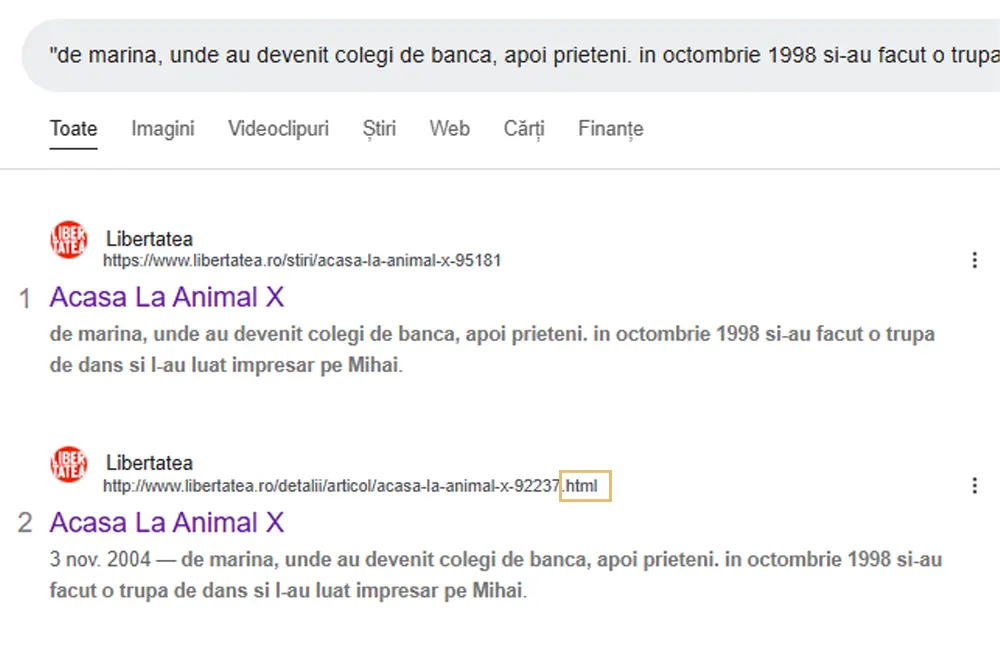
Among the pages that shouldn’t be indexed are leftover URLs from an older CMS that carry the .html extension. Even though the redirect from .html to the current page version is correctly configured, something appears to be delaying or preventing deindexation.
I didn’t find any internal links or backlinks pointing to the .html URL shown, though it’s still possible backlinks exist from sources not tracked by ahrefs – social media, for example.
site:libertatea.ro filetype:html
Subdomains with errors (partially resolved)
The original audit file flagged several subdomains with errors. By the time the video was recorded those issues were being addressed, and they have since been fully resolved. You can see the original problem documented in the video at the 07:00 mark.
In short, I found multiple duplicate domains – one appeared to be a dedicated section for ‘Rebus’, another for something called ‘Intrebarea Zilei’ (‘Question of the Day’). Both have since been completely removed and deindexed.
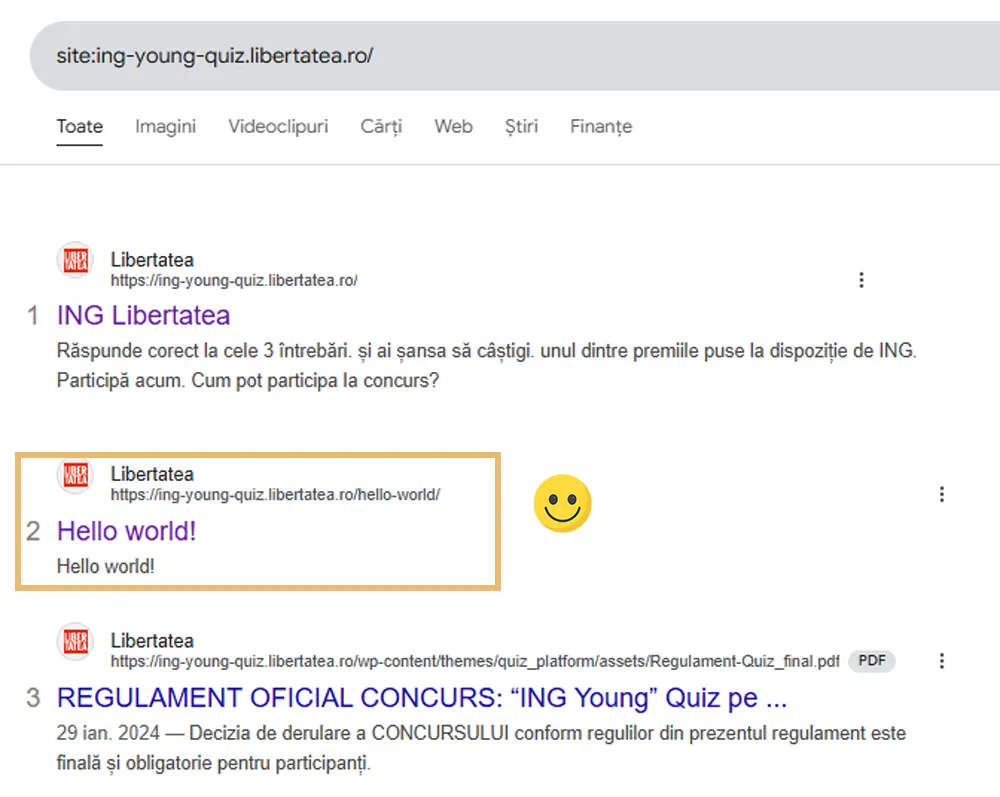
One subdomain did slip through, however – a page dedicated to an ING contest. It’s a one-page mini-site containing a PDF file and a ‘Hello World‘ page :).
site:ing-young-quiz.libertatea.ro/
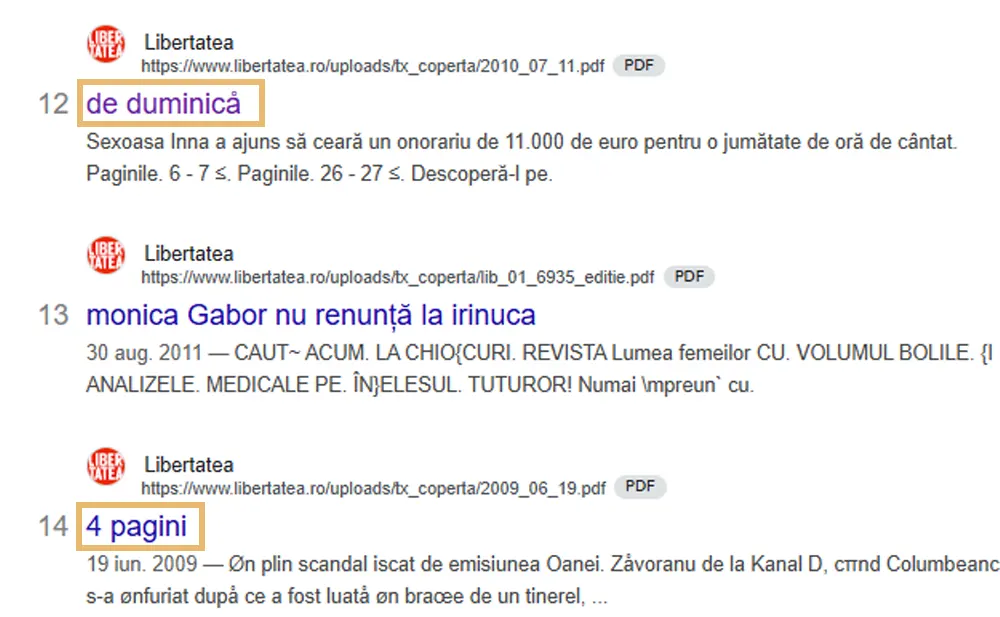
Many redundant .pdf pages
In other audits – like the Farmacia Tei one, where I found numerous indexed product leaflet PDFs – there’s at least an argument to be made for keeping them indexed. At libertatea.ro, these pages seem even harder to justify.
They don’t appear to target any meaningful search intent, they’re not optimized for search engines, and their titles are auto-generated rather than written for discoverability.
site:libertatea.ro filetype:pdf
The site appears to frequently hit its rate limit
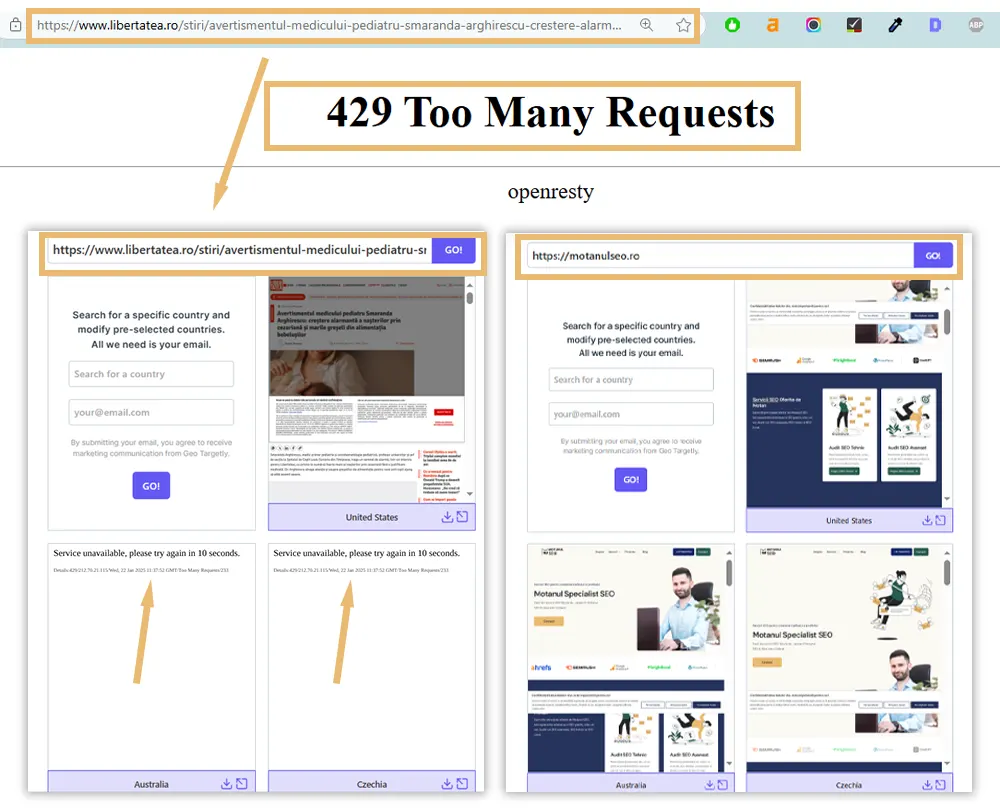
This is an unusual one – but potentially significant. On at least three separate occasions I was unable to load pages on the site, receiving a ‘429 Too Many Requests‘ error.
It’s possible the rate limit was triggered by my use of Chrome extensions that check the status code of every link on a page. However, when I tried accessing the site from a different IP address, I got the same error – suggesting it may affect regular users as well.
For comparison, my own site was fully accessible at the same time.
Redirect chain on the homepage
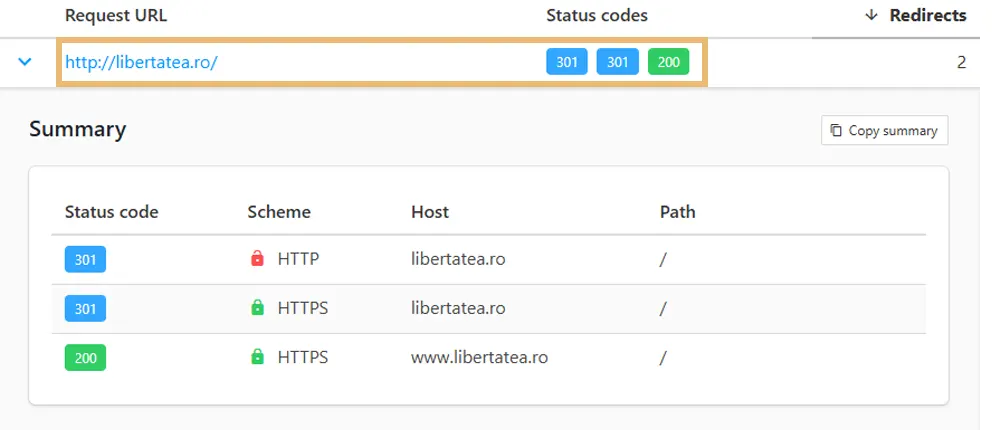
A basic SEO best practice is to avoid redirect chains, especially on the homepage.
Here we have a fairly common one: the non-secure version http://libertatea.ro/ first performs a 301 redirect to https://libertatea.ro/, which then redirects again to the www version.
- SEO Tip: To inspect 301 redirect chains and 404 statuses across multiple URLs at once, use httpstatus.io.
301 redirect in footer
Still on the topic of redirects – there’s a 301 in the site’s footer, an issue I’ve found on every site audited so far, with dedeman.ro having the most instances.
Having just one is actually impressive by comparison. And since this particular redirect points to an external URL rather than an internal one, the impact is relatively minor.
Other minor issues found
A few additional low-priority findings worth a brief mention:
- A sitemap.xml that only surfaces a limited number of articles rather than the full site - see here.
- A few indexed .xls files and one indexed .txt file.
- Pages with placeholder images - likely older posts that had no featured image, which ended up with a generic placeholder applied after a CMS or theme migration - example here or here.
What's working well
I’ve spent most of this audit on problems, so it’s only fair to call out what libertatea.ro is doing right.
- Well-structured sitemap: The sitemap at https://www.libertatea.ro/news-sitemap is genuinely well done - pages are organized in a way that's intuitive to navigate.
- Celebrity profile pages: Detailed profile pages with dynamically recommended content relevant to the featured person, such as /persoana/donald-trump.
- Very few 404 errors: For a site of this size, finding only 19 broken external links is a strong result. For context, the Dr. Max audit turned up 160.
Conclusion
Overall, my impression of libertatea.ro from an SEO standpoint is a positive one. The comments page setup is essentially the only issue that feels genuinely problematic and could be causing real harm.
The indexed .html pages appear to be a temporary situation – in theory, Google should have deindexed them by now.
The 429 rate limit errors were most likely triggered by my own audit process rather than being a widespread user-facing issue. That said, it’s worth noting that none of the other sites I’ve audited using the exact same workflow triggered this behavior.
What did you think of this technical SEO analysis? Did anything stand out, or is there something you think could be covered better? Leave a comment below.
Interested in this type of service? Visit my Technical SEO Audit page, or if you’re looking for something more in-depth, I also offer advanced SEO audits.

My name is Andrei and in 2014 I made money online for the first time through websites and SEO. I currently offer SEO services for Romanian and English-language websites. You can also find me on my YouTube channel with SEO tutorials. For SEO education, I invite you to visit my SEO blog or the page with SEO case studies.